Application
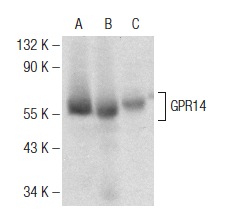
Western blot analysis of GPR14 expression in mouse heart (A), rat heart (B) and mouse pancreas (C) tissue extract.| Product Name | GPR14 Antibody (M-250) |
|---|---|
| Antibody Type | Primary Antibodies |
| Antigen Alias | epitope corresponding to amino acids 136-385 mapping at the C-terminus of GPR14 of mouse origin |
| Modification Notes | GPR14 (G-protein-coupled receptor), also designated SENR (sensory epithelium neuropeptide-like receptor), was initially cloned as an ‘orphan’ receptor, which is a receptor that binds an unidentified natural ligand. Further studies have shown that urotensin II (UII), a cyclic neuropeptide, binds to GPR14 with very high affinity. Subsequently, cells transfected with GPR14 experience an increase in calcium concentration upon binding of urotensin II. It is the calcium influx and localization of GPR14 in heart tissues that suggests GPR14 may play a role in the contraction of vascular smooth muscles in response to the specific binding of urotensin II. GPRI4 is also detected in pancreas and, to a lesser extent, in brain tissues. |
| Clonality | Polyclonal |
|---|---|
| Isotype | IgG |
| Host Species | Rabbit |
| Tested Applications | WBIPIFELISA |
| recommended for detection of GPR14 of mouse, rat and human origin by WB, IP, IF and ELISA: |
|
| Species Reactivity | HumanMouseRat |
| Concentration | 1mg/ml |
| Purification | Affinity purified |
| Alternative Names | epitope corresponding to amino acids 136-385 mapping at the C-terminus of GPR14 of mouse origin |
|---|---|
| Tissue Specificity | epitope corresponding to amino acids 136-385 mapping at the C-terminus of GPR14 of mouse origin |
| Entrez Gene | 2837 |
|---|
Application
Western blot analysis of GPR14 expression in mouse heart (A), rat heart (B) and mouse pancreas (C) tissue extract.| Application Notes | recommended for detection of GPR14 of mouse, rat and human origin by WB, IP, IF and ELISA: |
|---|
| Form | Liquid |
|---|---|
| Storage Instructions | For short-term storage, store at 4° C. For long-term storage, aliquot and store at -20ºC or below. Avoid multiple freeze-thaw cycles. |
| Storage Buffer | phosphate buffered saline , pH 7.4, 150mM NaCl, 0.02% sodium azide and 50% glycerol. |


