Application
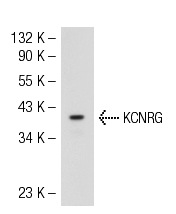
Western blot analysis of KCNRG expression in SK-BR-3 whole cell lysate.| Product Name | KCNRG Antibody (E-12) |
|---|---|
| Antibody Type | Primary Antibodies |
| Antigen Alias | epitope mapping within an internal region of KCNRG of human origin |
| Modification Notes | Voltage-gated K+ channels in the plasma membrane control the repolarization and the frequency of action potentials in neurons, muscles, and other excitable cells. The KV gene family encodes more than 30 genes that comprise the subunits of the K+ channels and they vary in their gating and permeation properties, subcellular distribution and expression patterns. The potassium channel regulator KCNRG inhibits potassium fluxes in cells, specifically through Kv1.1 and Kv1.4 channels. KCNRG maps to human chromosome 13q, a region frequently prone to deletions. Subsequently, loss of the tumor suppressor actions of KCNRG has been shown to lead to gastrointestinal stromal tumors, hepatocellular carcinomas, as well as other soft tissue tumors. In addition, production of autoantibodies to KCNRG contribute to the pulmonary symptoms of patients with autoimmune polyendocrine syndrome type 1 (APS-1). |
| Clonality | Polyclonal |
|---|---|
| Isotype | IgG |
| Host Species | Rabbit |
| Tested Applications | WBIPIFELISA |
| recommended for detection of KCNRG of h and r origin by WB, IP, IF and ELISA also reactive with additional species, including canine, bovine and porcine: |
|
| Species Reactivity | HumanMouseRat |
| Concentration | 1mg/ml |
| Purification | Affinity purified |
| Alternative Names | epitope mapping within an internal region of KCNRG of human origin |
|---|---|
| Tissue Specificity | epitope mapping within an internal region of KCNRG of human origin |
| Entrez Gene | 283518 |
|---|
Application
Western blot analysis of KCNRG expression in SK-BR-3 whole cell lysate.| Application Notes | recommended for detection of KCNRG of h and r origin by WB, IP, IF and ELISA also reactive with additional species, including canine, bovine and porcine: |
|---|
| Form | Liquid |
|---|---|
| Storage Instructions | For short-term storage, store at 4° C. For long-term storage, aliquot and store at -20ºC or below. Avoid multiple freeze-thaw cycles. |
| Storage Buffer | phosphate buffered saline , pH 7.4, 150mM NaCl, 0.02% sodium azide and 50% glycerol. |


