Application
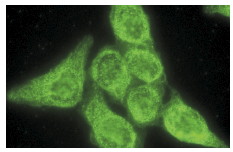
Immunofluorescence staining of methanol-fixed HeLa cells showing cytoplasmic and membrane localization.| Product Name | Gem Antibody (H-85) |
|---|---|
| Antibody Type | Primary Antibodies |
| Antigen Alias | epitope corresponding to amino acids 1-85 mapping at the N-terminus of Gem of human origin |
| Modification Notes | Gem belongs to the Rad/Gem/Kir (RGK) subfamily of Ras-related GTPases, which lack typical C-terminal amino acid motifs for isoprenylation. Rad and Gem bind calmodulin in a Ca2+-dependent manner via this C-terminal extension, involving residues 278–297 in human Rad. High intracellular Gem levels, which interact with intact microtubules and microfilaments, promote profound changes in cell morphology. Ectopic Gem expression is sufficient to stimulate cell flattening and neurite extension in N1E-115 and SH-SY5Y neuroblastoma cells, suggesting a role for Gem in cytoskeletal rearrangement and/or morphological differentiation of neurons. Gem was also observed in developing trigeminal nerve ganglia in 12.5 day mouse embryos, demonstrating that Gem expression is a property of normal ganglionic development. The interaction of Gem with beta-subunits regulates Ca2+ channel expression at the cell surface. The human Gem gene maps to chromosome 8q22.1. |
| Clonality | Polyclonal |
|---|---|
| Isotype | IgG |
| Host Species | Rabbit |
| Tested Applications | WBIPIFELISA |
| recommended for detection of Gem of mouse, rat and human origin by WB, IP, IF and ELISA also reactive with additional species, including equine, canine, bovine and porcine: |
|
| Species Reactivity | HumanMouseRat |
| Concentration | 1mg/ml |
| Purification | Affinity purified |
| Alternative Names | epitope corresponding to amino acids 1-85 mapping at the N-terminus of Gem of human origin |
|---|---|
| Tissue Specificity | epitope corresponding to amino acids 1-85 mapping at the N-terminus of Gem of human origin |
| Entrez Gene | 2669 |
|---|
Application
Immunofluorescence staining of methanol-fixed HeLa cells showing cytoplasmic and membrane localization.| Application Notes | recommended for detection of Gem of mouse, rat and human origin by WB, IP, IF and ELISA also reactive with additional species, including equine, canine, bovine and porcine: |
|---|
| Form | Liquid |
|---|---|
| Storage Instructions | For short-term storage, store at 4° C. For long-term storage, aliquot and store at -20ºC or below. Avoid multiple freeze-thaw cycles. |
| Storage Buffer | phosphate buffered saline , pH 7.4, 150mM NaCl, 0.02% sodium azide and 50% glycerol. |


