Application
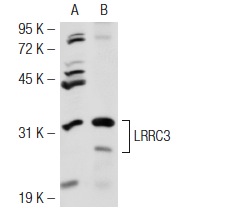
Western blot analysis of LRRC3 expression in HEK293 whole cell lysate (A) and mouse brain tissue extract (B).| Product Name | LRRC3 Antibody (K-12) |
|---|---|
| Antibody Type | Primary Antibodies |
| Antigen Alias | epitope mapping within an internal region of LRRC3 of human origin |
| Modification Notes | Leucine-rich repeats (LRRs) are 20-29 amino acid motifs that mediate protein-protein interactions. The primary function of these motifs is to provide a versatile structural framework for the formation of these protein-protein interactions. LRRs are present in a variety of proteins with diverse structure and function, including innate immunity and nervous system development. Several human diseases are associated with mutations in genes encoding LRR-containing proteins. The leucine-rich repeat-containing protein 3 (LRRC3 or LRRC3A) is a 257 amino acid protein that contains 3 LRR repeats. The gene encoding LRRC3 maps to chromosome 21, the smallest of the human chromosomes. Chromosome 21 contains nearly 300 genes and 47 million base pairs. Down syndrome, also known as trisomy 21, is the disease most commonly associated with chromosome 21. Translocations are found to occur between chromosome 21 and 8, and chromosome 21 and 12, in certain leukemias. |
| Clonality | Polyclonal |
|---|---|
| Isotype | IgG |
| Host Species | Rabbit |
| Tested Applications | WBIPIFELISA |
| recommended for detection of LRRC3 of mouse, rat and human origin by WB, IP, IF and ELISA non cross-reactive with other LRRC family members also reactive with additional species, including canine and bovine: |
|
| Species Reactivity | HumanMouseRat |
| Concentration | 1mg/ml |
| Purification | Affinity purified |
| Alternative Names | epitope mapping within an internal region of LRRC3 of human origin |
|---|---|
| Tissue Specificity | epitope mapping within an internal region of LRRC3 of human origin |
| Entrez Gene | 81543 |
|---|
Application
Western blot analysis of LRRC3 expression in HEK293 whole cell lysate (A) and mouse brain tissue extract (B).| Application Notes | recommended for detection of LRRC3 of mouse, rat and human origin by WB, IP, IF and ELISA non cross-reactive with other LRRC family members also reactive with additional species, including canine and bovine: |
|---|
| Form | Liquid |
|---|---|
| Storage Instructions | For short-term storage, store at 4° C. For long-term storage, aliquot and store at -20ºC or below. Avoid multiple freeze-thaw cycles. |
| Storage Buffer | phosphate buffered saline , pH 7.4, 150mM NaCl, 0.02% sodium azide and 50% glycerol. |


