Application
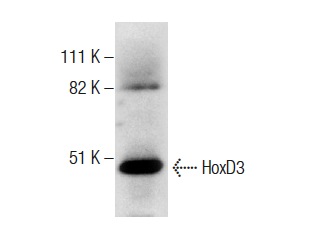
Western blot analysis of HoxD3 expression in human skeletal muscle tissue extract.| Product Name | HoxD3 Antibody (H-44) |
|---|---|
| Antibody Type | Primary Antibodies |
| Antigen Alias | epitope corresponding to amino acids 341-384 mapping within an internal region of HoxD3 of human origin |
| Modification Notes | The Hox (homeobox) genes play an important role in the development and design of anterior-posterior body axes in animals. Although Hox proteins can bind to DNA as monomers, dimerization with PBX homeoproteins can significantly increase the DNA binding activity of these transcription factors. HoxD3, a homeobox transcription factor that promotes angiogenesis and collagen synthesis, is up-regulated during normal wound repair and may provide a means to directly improve collagen deposition, angiogenesis and closure in poorly healing wounds in diabetics. One study found that six of seven observed melanoma cell lines expressed the HoxD3 gene, whereas normal melanocytes did not. When overexpressed, HoxD3 upregulates Integrin ∫3 expression in human erythroleukemia HEL cells and lung cancer A549 cells and enhances their motility and invasiveness. HoxD3 may also enhance the invasive and metastatic potential of cancer cells through TGF∫-dependent and independent pathways. |
| Clonality | Polyclonal |
|---|---|
| Isotype | IgG |
| Host Species | Rabbit |
| Tested Applications | WBIPIFELISAGSChIP |
| recommended for detection of HoxD3 of mouse, rat and human origin by WB, IP, IF and ELISA also reactive with additional species, including equine, canine, bovine and porcine: |
|
| Species Reactivity | HumanMouseRat |
| Concentration | 1mg/ml |
| Purification | Affinity purified |
| Alternative Names | epitope corresponding to amino acids 341-384 mapping within an internal region of HoxD3 of human origin |
|---|---|
| Tissue Specificity | epitope corresponding to amino acids 341-384 mapping within an internal region of HoxD3 of human origin |
| Entrez Gene | 3232 |
|---|
Application
Western blot analysis of HoxD3 expression in human skeletal muscle tissue extract.| Application Notes | recommended for detection of HoxD3 of mouse, rat and human origin by WB, IP, IF and ELISA also reactive with additional species, including equine, canine, bovine and porcine: |
|---|
| Form | Liquid |
|---|---|
| Storage Instructions | For short-term storage, store at 4° C. For long-term storage, aliquot and store at -20ºC or below. Avoid multiple freeze-thaw cycles. |
| Storage Buffer | phosphate buffered saline , pH 7.4, 150mM NaCl, 0.02% sodium azide and 50% glycerol. |


