Application
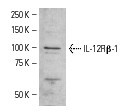
Western blot analysis of IL-12Rβ-1 expression in BYDP whole cell lysate.| Product Name | IL-12Rβ1 Antibody (M-240) |
|---|---|
| Antibody Type | Primary Antibodies |
| Modification Notes | IL-12, a heterodimeric cytokine composed of two disulfide-bonded glycoprotein subunits, p35 and p40, has pleiotrophic activities including stimulation of the proliferation of activated T and NK cells, induction of IFN-g production by PBMCs, enhancement of the lytic activity of NK/LAK cells and promotion of T helper (Th) 1 cell responses. The T cell response to IL-12 is mediated through two receptor proteins, designated IL-12Rb1 and IL-12Rb2. The genes encoding human IL-12Rb1 and IL-12Rb2 map to chromosomes 19p13.1 and 1p31.3, respectively. Increased IL-12Rb2 expression is crucial in regulating Th1 differentiation, whereas IL-12Rb1 expression is less restricted. Inhibition of IL-12 activity may provide treatment for diseases associated with pathologic Th1 responses, such as multiple sclerosis or Crohn’s disease, while administration of recombinant IL-12 may aid in the treatment for allergic disorders and asthma. |
| Clonality | Polyclonal |
|---|---|
| Isotype | IgG |
| Host Species | Rabbit |
| Tested Applications | WBIPIFELISA |
| recommended for detection of IL-12R&beta1 of mouse and rat origin by WB, IP, IF and ELISA | |
| Species Reactivity | HumanMouseRat |
| Concentration | 1mg/ml |
| Purification | Affinity purified |
| Alternative Names | epitope corresponding to amino acids 1-240 of IL-12R&beta 1 of mouse origin |
|---|---|
| Tissue Specificity | epitope corresponding to amino acids 1-240 of IL-12Rβ1 of mouse origin |
| Entrez Gene | 16161 |
|---|
Application
Western blot analysis of IL-12Rβ-1 expression in BYDP whole cell lysate.| Application Notes | recommended for detection of IL-12R&beta1 of mouse and rat origin by WB, IP, IF and ELISA |
|---|
| Form | Liquid |
|---|---|
| Storage Instructions | For short-term storage, store at 4° C. For long-term storage, aliquot and store at -20ºC or below. Avoid multiple freeze-thaw cycles. |
| Storage Buffer | phosphate buffered saline , pH 7.4, 150mM NaCl, 0.02% sodium azide and 50% glycerol. |


