Application
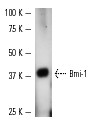
Western blot analysis of Bmi-1 expression in K-562 nuclear extract.| Product Name | Bmi-1 Antibody (H-99) |
|---|---|
| Antibody Type | Primary Antibodies |
| Modification Notes | In Drosophila, Polycomb (Pc-g) gene family encodes chromatin proteins that are required for the repression of homeotic loci in embryonic development. Mel-18 and Bmi-1 are mammalian homologs of Drosophila Pc-g group proteins, as they are similarly expressed during development and implicated in the regulation of gene expression, axial skeleton development, and the control of proliferation and survival of hematopoietic cells. Mel-18 directly binds to DNA through a ring-finger motif and preferentially associates with juxtaposed enhancer elements on various genes, including Bcl-2, c-Myc and Hox. Mel-18 is an immediate early response gene within the c-Myc/Cdc25 signaling cascade that exhibits tumor suppressor activity and negatively regulates cell cycle progression by blocking S phase entry. Alternatively, Bmi-1 has been identified as a potent oncogene as it contributes to the transcriptional activation of genes implicated in early lymphoid development. Proviral activation of Bmi-1 expression corresponds to enhanced gene-specific activation of other proto-oncogenes, including c-Myc and Pim, subsequently resulting in the progression of lymphomagenesis. |
| Clonality | Polyclonal |
|---|---|
| Isotype | IgG |
| Host Species | Rabbit |
| Tested Applications | WBIPIFELISAGSChIP |
| recommended for detection of Bmi-1 of mouse, rat and human origin by WB, IP, IF and ELISA also reactive with additional species, including equine, canine, bovine, porcine and avian | |
| Species Reactivity | HumanMouseRat |
| Concentration | 1mg/ml |
| Purification | Affinity purified |
| Alternative Names | epitope corresponding to amino acids 228-326 mapping at the C-terminus of Bmi-1 of human origin |
|---|---|
| Tissue Specificity | epitope corresponding to amino acids 228-326 mapping at the C-terminus of Bmi-1 of human origin |
| Entrez Gene | 648 |
|---|
Application
Western blot analysis of Bmi-1 expression in K-562 nuclear extract.| Application Notes | recommended for detection of Bmi-1 of mouse, rat and human origin by WB, IP, IF and ELISA also reactive with additional species, including equine, canine, bovine, porcine and avian |
|---|
| Form | Liquid |
|---|---|
| Storage Instructions | For short-term storage, store at 4° C. For long-term storage, aliquot and store at -20ºC or below. Avoid multiple freeze-thaw cycles. |
| Storage Buffer | phosphate buffered saline , pH 7.4, 150mM NaCl, 0.02% sodium azide and 50% glycerol. |


