Application
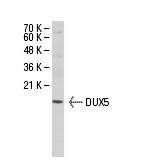
Western blot analysis of DUX5 expression in Hep G2 whole cell lysate.| Product Name | DUX5 Antibody (U-20) |
|---|---|
| Antibody Type | Primary Antibodies |
| Modification Notes | The double homeobox (DUX) proteins are encoded by 3.3-kilobase repeats found throughout the human genome. The DUX family includes DUX1, DUX2, DUX3, DUX4 and DUX5. Each of these family members, excluding DUX2, contains two homeobox domains. DUX2 contains only one homeobox domain. DUX1 and DUX5 are identical to one another and they share 98% identity with DUX3 and approximately 70% identity with DUX2. The genes encoding DUX5 and DUX3 both contain additional start sites that result in N-terminal extended isoforms. The homeodomains found in DUX5 and DUX1 are similar to those found in Pax-3, Pax-7, OTX1 and OTX2. DUX4, also known as DUX10, is capable of forming homodimers. In addition, the gene encoding DUX4 maps within the D4Z4 repeat unit that has been implicated in Facioscapulohumeral muscular dystrophy (FSHD). |
| Clonality | Polyclonal |
|---|---|
| Isotype | IgG |
| Host Species | Rabbit |
| Tested Applications | WBIPELISA |
| Species Reactivity | HumanMouseRat |
| Concentration | 1mg/ml |
| Purification | Affinity purified |
| Alternative Names | recommended for detection of DUX5 of human origin by WB IP and ELISA |
|---|---|
| Tissue Specificity | recommended for detection of DUX5 of human origin by WB, IP and ELISA |
| Entrez Gene | 26581 |
|---|
Application
Western blot analysis of DUX5 expression in Hep G2 whole cell lysate.| Form | Liquid |
|---|---|
| Storage Instructions | For short-term storage, store at 4° C. For long-term storage, aliquot and store at -20ºC or below. Avoid multiple freeze-thaw cycles. |
| Storage Buffer | phosphate buffered saline , pH 7.4, 150mM NaCl, 0.02% sodium azide and 50% glycerol. |


