Application
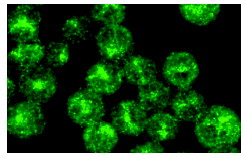
Immunofluorescence staining of methanol-fixed Ramos cells showing nuclear and cytoplasmic localization.| Product Name | AID Antibody (H-80) |
|---|---|
| Antibody Type | Primary Antibodies |
| Antigen Alias | epitope corresponding to amino acids 119-198 mapping at the C-terminus of AID of human origin |
| Modification Notes | Activation-induced Cytidine Deaminase (AID, HIGM-2) is a 198-amino acid, RNA-editing enzyme that contains a conserved cytidine deaminase motif and plays an important role in B-cell terminal differentiation. AID is expressed in germinal center B cells and contributes to the production of neutralizing antibodies IgG, IgA, and IgE. Hyper-IgM syndrome (HIGM2) patients that have deficient levels of AID show the absence of immuno-globulin class switch recombination (CSR), lack of immuno-globulin somatic hypermutations, and lymph node hyperplasia mediated by the presence of giant germinal centers. Furthermore, AID-/- mice are defective in CSR and also show a hyper-IgM phenotype, characterized by enlarged germinal centers containing active B cells. AID thus appears to be required in several stages of B-cell terminal differentiation that are necessary for efficient antibody responses such as B cell proliferation, immunoglobulin somatic hypermutations and CSR. |
| Clonality | Polyclonal |
|---|---|
| Isotype | IgG |
| Host Species | Rabbit |
| Tested Applications | WBIPIFELISA |
| recommended for detection of AID of mouse, rat and human origin by WB, IP, IF and ELISA also reactive with additional species, including equine, canine, bovine, porcine and avian: |
|
| Species Reactivity | HumanMouseRat |
| Concentration | 1mg/ml |
| Purification | Affinity purified |
| Alternative Names | epitope corresponding to amino acids 119-198 mapping at the C-terminus of AID of human origin |
|---|---|
| Tissue Specificity | epitope corresponding to amino acids 119-198 mapping at the C-terminus of AID of human origin |
| Entrez Gene | 57379 |
|---|
Application
Immunofluorescence staining of methanol-fixed Ramos cells showing nuclear and cytoplasmic localization.| Application Notes | recommended for detection of AID of mouse, rat and human origin by WB, IP, IF and ELISA also reactive with additional species, including equine, canine, bovine, porcine and avian: |
|---|
| Form | Liquid |
|---|---|
| Storage Instructions | For short-term storage, store at 4° C. For long-term storage, aliquot and store at -20ºC or below. Avoid multiple freeze-thaw cycles. |
| Storage Buffer | phosphate buffered saline , pH 7.4, 150mM NaCl, 0.02% sodium azide and 50% glycerol. |


