Application
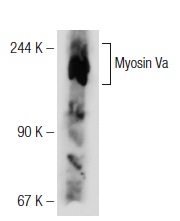
Western blot analysis of Myosin Va expression in KNRK whole cell lysate.| Product Name | Myosin Va Antibody (H-90) |
|---|---|
| Antibody Type | Primary Antibodies |
| Antigen Alias | epitope corresponding to amino acids 981-1070 mapping to an internal region of Myosin Va of human origin |
| Modification Notes | Myosin Va, a member of the unconventional myosin family, is a non-muscle myosin that structurally combines elements from both nonmuscle myosin type I and nonmuscle myosin type II. Class V unconventional myosins, which include Myosin Va and Myosin Vb, are nonfilamentous, actin-binding enzymes that appear to be expressed ubiquitously. Myosin V proteins are regulated by their heavy chain phosphorylation, which occurs in the carboxy-terminal tail domain. The mouse myosin Va gene is also known as the mouse dilute gene because mutations in this gene cause the coat color in mice to lighten. Mutations in the Myosin Va gene also result in the onset of severe neurological defects shortly after birth. Defects in the human Myosin Va gene, which maps to chromosome 15q21.2, have been implicated in Griscelli disease, a rare autosomal recessive disorder characterized by pigmentary dilution, variable cellular immunodeficiency and onset of acute, uncontrolled lymphocyte and macrophage activation. |
| Clonality | Polyclonal |
|---|---|
| Isotype | IgG |
| Host Species | Rabbit |
| Tested Applications | WBIPIFELISA |
| recommended for detection of Myosin Va of mouse, rat and human origin by WB, IP, IF and ELISA also reactive with additional species, including equine, canine, bovine and porcine: |
|
| Species Reactivity | HumanMouseRat |
| Concentration | 1mg/ml |
| Purification | Affinity purified |
| Alternative Names | epitope corresponding to amino acids 981-1070 mapping to an internal region of Myosin Va of human origin |
|---|---|
| Tissue Specificity | epitope corresponding to amino acids 981-1070 mapping to an internal region of Myosin Va of human origin |
| Entrez Gene | 4644 |
|---|
Application
Western blot analysis of Myosin Va expression in KNRK whole cell lysate.| Application Notes | recommended for detection of Myosin Va of mouse, rat and human origin by WB, IP, IF and ELISA also reactive with additional species, including equine, canine, bovine and porcine: |
|---|
| Form | Liquid |
|---|---|
| Storage Instructions | For short-term storage, store at 4° C. For long-term storage, aliquot and store at -20ºC or below. Avoid multiple freeze-thaw cycles. |
| Storage Buffer | phosphate buffered saline , pH 7.4, 150mM NaCl, 0.02% sodium azide and 50% glycerol. |


