Application
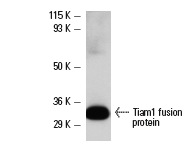
Western blot analysis of human recombinant Tiam1 fusion protein.| Product Name | Tiam1 Antibody (N-15) |
|---|---|
| Antibody Type | Primary Antibodies |
| Modification Notes | A gene designated Tiam1 was originally identified as an invasion-inducing gene by proviral tagging in combination with in vitro selection for invasiveness. Transfection of truncated Tiam1 cDNAs into noninvasive cells made these cells invasive. The predicted Tiam1 protein exhibits both Dbl and Pleckstrin-homologous domains characteristic of GDP-GTP exchange proteins for Rho-like proteins that have been implicated in cytoskeletal organization. In fibroblasts, Tiam1 induces a phenotype similar to that of constitutively activated (V12) Rac1, including membrane ruffling, and this is inhibited by dominant negative (N17) Rac1. Moreover, T lymphoma cells expressing (V12) Rac1 become invasive, supporting the suggestion that the Tiam1-Rac signaling pathway may be involved in the invasion and metastasis of tumor cells. |
| Clonality | Polyclonal |
|---|---|
| Isotype | IgG |
| Host Species | Rabbit |
| Tested Applications | WBIPIFELISA |
| recommended for detection of Tiam1 of mouse, rat and human origin by WB, IP, IF and ELISA also reactive with additional species, including equine and canine | |
| Species Reactivity | HumanMouseRat |
| Concentration | 1mg/ml |
| Purification | Affinity purified |
| Alternative Names | epitope mapping at the N-terminus of Tiam1 of mouse origin |
|---|---|
| Tissue Specificity | epitope mapping at the N-terminus of Tiam1 of mouse origin |
| Entrez Gene | 7074 |
|---|
Application
Western blot analysis of human recombinant Tiam1 fusion protein.| Application Notes | recommended for detection of Tiam1 of mouse, rat and human origin by WB, IP, IF and ELISA also reactive with additional species, including equine and canine |
|---|
| Form | Liquid |
|---|---|
| Storage Instructions | For short-term storage, store at 4° C. For long-term storage, aliquot and store at -20ºC or below. Avoid multiple freeze-thaw cycles. |
| Storage Buffer | phosphate buffered saline , pH 7.4, 150mM NaCl, 0.02% sodium azide and 50% glycerol. |


