Application
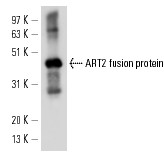
Western blot analysis of mouse recombinant ART2 fusion protein.| Product Name | ART2 Antibody (M-90) |
|---|---|
| Antibody Type | Primary Antibodies |
| Modification Notes | Mono-ADP-ribosylation is one of the posttranslational protein modifications regulating cellular metabolism, e.g. nitrogen fixation, in prokaryotes. Mono-ADP-ribosylation is a posttranslational modification of proteins in which the ADP-ribose moiety of nicotinamide adenine dinucleotide is transferred to an acceptor amino acid. Five mammalian ADP-ribosyltransferases (ART1-ART5) have been cloned, and expression is restricted to tissues such as cardiac and skeletal muscle, leukocytes, brain and testis. ART1 and ART2 are glycosyl-phosphatidylinositol (GPI)-anchored ectoenzymes expressed at the cell surface of rat and mouse T lymphocytes. ART1 is a protein that is expressed in human skeletal muscle. In skeletal muscle and lymphocytes, ART1 modifies specific members of the Integrin family of adhesion molecules, suggesting that ADP-ribosylation affects cell-matrix or cell-cell interactions. |
| Clonality | Polyclonal |
|---|---|
| Isotype | IgG |
| Host Species | Rabbit |
| Tested Applications | WBIPIFELISA |
| recommended for detection of ART2 of mouse and rat origin by WB, IP, IF and ELISA | |
| Species Reactivity | HumanMouseRat |
| Concentration | 1mg/ml |
| Purification | Affinity purified |
| Alternative Names | epitope corresponding to amino acids 41-130 mapping near the N-terminus of ART2 of mouse origin |
|---|---|
| Tissue Specificity | epitope corresponding to amino acids 41-130 mapping near the N-terminus of ART2 of mouse origin |
| Entrez Gene | 11871 |
|---|
Application
Western blot analysis of mouse recombinant ART2 fusion protein.| Application Notes | recommended for detection of ART2 of mouse and rat origin by WB, IP, IF and ELISA |
|---|
| Form | Liquid |
|---|---|
| Storage Instructions | For short-term storage, store at 4° C. For long-term storage, aliquot and store at -20ºC or below. Avoid multiple freeze-thaw cycles. |
| Storage Buffer | phosphate buffered saline , pH 7.4, 150mM NaCl, 0.02% sodium azide and 50% glycerol. |


