Application
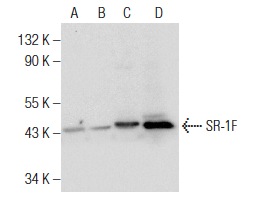
Western blot analysis of SR-1F expression in BC3H1 (A) and SK-N-SH (B) whole cell lysates and mouse brain (C) and mouse heart (D) tissue extracts.| Product Name | SR-1F Antibody (H-85) |
|---|---|
| Antibody Type | Primary Antibodies |
| Modification Notes | The members of the G-protein-coupled receptor family are distinguished by their slow transmitting response to ligand binding. These seven transmembrane proteins include the adrenergic, serotonin and dopamine receptors. The effect of the signaling molecule can be excitatory or inhibitory depending on the type of receptor to which it binds. b-adrenergic bound to adrenaline activates adenylyl cyclase, while a2-adrenergic receptor bound to adrenaline inhibits adenylyl cyclase. Like the a2-adrenergic receptor, serotonin receptor functions are also mediated by G proteins that inhibit the activity of adenylyl cyclase. The serotonin receptors have been classified into several categories, designated SR-1–7 (5HT1–7). Subtypes within the SR-1 group include SR-1A, -1B, -1D, -1E and -1F. |
| Clonality | Polyclonal |
|---|---|
| Isotype | IgG |
| Host Species | Rabbit |
| Tested Applications | WBIPIFELISA |
| recommended for detection of SR-1F of mouse, rat and human origin by WB, IP, IF and ELISA also reactive with additional species, including equine, canine, bovine and porcine | |
| Species Reactivity | HumanMouseRat |
| Concentration | 1mg/ml |
| Purification | Affinity purified |
| Alternative Names | epitope corresponding to amino acids 201-285 mapping to an internal region of SR-1F of human origin |
|---|---|
| Tissue Specificity | epitope corresponding to amino acids 201-285 mapping to an internal region of SR-1F of human origin |
| Entrez Gene | 3355 |
|---|
Application
Western blot analysis of SR-1F expression in BC3H1 (A) and SK-N-SH (B) whole cell lysates and mouse brain (C) and mouse heart (D) tissue extracts.| Application Notes | recommended for detection of SR-1F of mouse, rat and human origin by WB, IP, IF and ELISA also reactive with additional species, including equine, canine, bovine and porcine |
|---|
| Form | Liquid |
|---|---|
| Storage Instructions | For short-term storage, store at 4° C. For long-term storage, aliquot and store at -20ºC or below. Avoid multiple freeze-thaw cycles. |
| Storage Buffer | phosphate buffered saline , pH 7.4, 150mM NaCl, 0.02% sodium azide and 50% glycerol. |


