Application
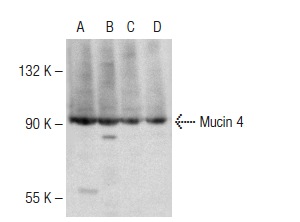
Western blot analysis of Mucin 4 expression in MCF7 (A), SW480 (B), HeLa (C) and SCC-4 (D) whole cell lysates.| Product Name | Mucin 4 Antibody (H-300) |
|---|---|
| Antibody Type | Primary Antibodies |
| Modification Notes | Mucins are a group of high molecular weight glycoproteins consisting of a mucin core protein and O-linked carbohydrates. Mucin 4, a membrane-bound mucin, is the human homolog of the rat sialomucin complex (SMC). Mucin 4 protein consists of Mucin 4å, a large amino mucin type subunit, and Mucin 4∫, a transmembrane subunit containing three EGF-like domains. The Mucin 4 gene is the predominant mucin gene expressed in the normal urothelium and is also expressed in several normal tissues such as trachea, lung and testis. Dysregulation of Mucin 4 results in high levels of expression in pancreatic tumors and tumor cell lines. Induction of Mucin 4 in pancreatic carcinoma by all-trans-retinoic acid is mediated through the retinoic acid receptor-å signaling pathway. TGF∫2 serves as an interim mediator of this regulated expression. Alternative splicing in the 3'-end of the Mucin 4 gene generates at least 12 splice variants, which are characterized as two distinct types, a secreted type and a membrane-associated type. Mucin 4 protein acts as a heterodimeric bifunctional cell-surface glycoprotein and forms thick mucous effusion in the diseased middle ear. |
| Clonality | Polyclonal |
|---|---|
| Isotype | IgG |
| Host Species | Rabbit |
| Tested Applications | WBIPIFELISA |
| recommended for detection of Mucin 4 of human and, to a lesser extent, mouse and rat origin by WB, IP, IF and ELISA | |
| Species Reactivity | HumanMouseRat |
| Concentration | 1mg/ml |
| Purification | Affinity purified |
| Alternative Names | epitope corresponding to amino acids 1870-2169 mapping at the C-terminus of Mucin 4 of human origin |
|---|---|
| Tissue Specificity | epitope corresponding to amino acids 1870-2169 mapping at the C-terminus of Mucin 4 of human origin |
| Entrez Gene | 4585 |
|---|
Application
Western blot analysis of Mucin 4 expression in MCF7 (A), SW480 (B), HeLa (C) and SCC-4 (D) whole cell lysates.| Application Notes | recommended for detection of Mucin 4 of human and, to a lesser extent, mouse and rat origin by WB, IP, IF and ELISA |
|---|
| Form | Liquid |
|---|---|
| Storage Instructions | For short-term storage, store at 4° C. For long-term storage, aliquot and store at -20ºC or below. Avoid multiple freeze-thaw cycles. |
| Storage Buffer | phosphate buffered saline , pH 7.4, 150mM NaCl, 0.02% sodium azide and 50% glycerol. |


