Application
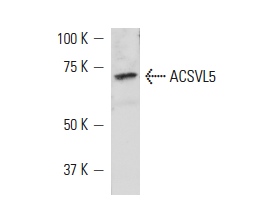
Western blot analysis of ACSVL5 expression in NIH/3T3 whole cell lysate.| Product Name | ACSVL5 Antibody (M-100) |
|---|---|
| Antibody Type | Primary Antibodies |
| Modification Notes | Acyl-coenzyme A synthetases (ACSs) are a large family of related enzymes known to catalyze the fundamental initial reaction in fatty acid metabolism. The ACS family is roughly characterized based on fatty acid chain length preference among different members. The nomenclature in the ACS family reflects this relationship and includes short-chain ACS (ACSS), medium-chain ACS (ACSM), long-chain ACS (ACSL) and very long-chain ACS (ACSVL). ACSVL family members are capable of activating both long-chain fatty acids (LCFAs) and very long-chain (VLCFAs) fatty acids. There are six members of the human ACSVL subfamily which have been described as solute carrier family 27A (SLC27A) gene products. They represent a group of evolutionarily conserved fatty acid transport proteins (FATPs) recognized for their role in facilitating translocation of long-chain fatty acids across the plasma membrane. The family nomenclature has recently been unified with their respective acyl-CoA synthetase family designations: ACSVL1 (FATP2), ACSVL2 (FATP6), ACSVL3 (FATP3), ACSVL4 (FATP4), ACSVL5 (FATP1) and ACSVL6 (FATP5). ACSVLs have unique expression patterns and are found in major organs of fatty acid metabolism, such as adipose tissue, liver, heart and kidney. |
| Clonality | Polyclonal |
|---|---|
| Isotype | IgG |
| Host Species | Rabbit |
| Tested Applications | WBIPIFELISA |
| recommended for detection of ACSVL5 of mouse, rat and human origin by WB, IP, IF and ELISA also reactive with additional species, including equine, bovine and porcine | |
| Species Reactivity | HumanMouseRat |
| Concentration | 1mg/ml |
| Purification | Affinity purified |
| Alternative Names | epitope corresponding to amino acids 41-140 mapping near the N-terminus of ACSVL5 of mouse origin |
|---|---|
| Tissue Specificity | epitope corresponding to amino acids 41-140 mapping near the N-terminus of ACSVL5 of mouse origin |
| Entrez Gene | 26457 |
|---|
Application
Western blot analysis of ACSVL5 expression in NIH/3T3 whole cell lysate.| Application Notes | recommended for detection of ACSVL5 of mouse, rat and human origin by WB, IP, IF and ELISA also reactive with additional species, including equine, bovine and porcine |
|---|
| Form | Liquid |
|---|---|
| Storage Instructions | For short-term storage, store at 4° C. For long-term storage, aliquot and store at -20ºC or below. Avoid multiple freeze-thaw cycles. |
| Storage Buffer | phosphate buffered saline , pH 7.4, 150mM NaCl, 0.02% sodium azide and 50% glycerol. |


