Application
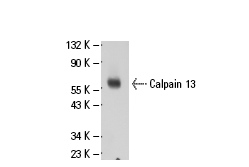
Western blot analysis of Calpain 13 expression in rat spleen tissue extract.| Product Name | Calpain 13 Antibody (M-300) |
|---|---|
| Antibody Type | Primary Antibodies |
| Modification Notes | Calpains are calcium-activated thiol proteases. They are heterodimers with one large subunit and one small subunit. The large subunit varies between family members and can be active without the small subunit. Calpains are involved in intracellular processing of proteins. Calpain 13, also called Sol H, is the most divergent caplain member. It is a homolog of Sol, an optic lobe gene product of Drosophila. Calpain 13 is a member of the non-EF-hand subfamily of calpains. Calpain 13 is composed of four domains and consists of 423 amino acid residues. It has a limited tissue distribution but has been found in human brain, testis and lung. |
| Clonality | Polyclonal |
|---|---|
| Isotype | IgG |
| Host Species | Rabbit |
| Tested Applications | WBIPIFELISA |
| recommended for detection of Calpain 13 of mouse and rat origin by WB, IP, IF and ELISA | |
| Species Reactivity | HumanMouseRat |
| Concentration | 1mg/ml |
| Purification | Affinity purified |
| Alternative Names | epitope corresponding to amino acids 366-665 mapping at the C-terminus of Calpain 13 of mouse origin |
|---|---|
| Tissue Specificity | epitope corresponding to amino acids 366-665 mapping at the C-terminus of Calpain 13 of mouse origin |
| Entrez Gene | 381122 |
|---|
Application
Western blot analysis of Calpain 13 expression in rat spleen tissue extract.| Application Notes | recommended for detection of Calpain 13 of mouse and rat origin by WB, IP, IF and ELISA |
|---|
| Form | Liquid |
|---|---|
| Storage Instructions | For short-term storage, store at 4° C. For long-term storage, aliquot and store at -20ºC or below. Avoid multiple freeze-thaw cycles. |
| Storage Buffer | phosphate buffered saline , pH 7.4, 150mM NaCl, 0.02% sodium azide and 50% glycerol. |


