Application
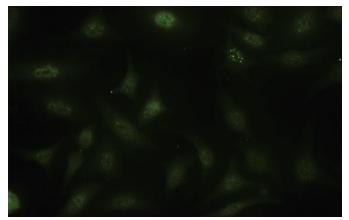
Immunofluorescence staining of methanol-fixed HeLa cells showing cytoplasmic localization.Application
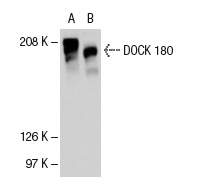
Western blot analysis of DOCK 180 expression in HeLa (A) and JAR (B) whole cell lysates.| Product Name | DOCK 180 Antibody (H-70) |
|---|---|
| Antibody Type | Primary Antibodies |
| Modification Notes | The v-Crk oncogene product shares homologous amino acid sequences, designated Src homology region 2 (SH2) and SH3, with many molecules involved in signal transduction (1,2). The v-Crk cellular homolog, c-Crk, is a member of a newly emerging class of genes including Nck and GRB2/ASH which encode proteins that consist primarily of SH2 and SH3 domains (3,4). Two distinct human c-Crk cDNAs, designated Crk I and Crk II, have been identified and shown to represent alternative splice products of c-Crk (3,4). The major translational product of c-Crk I has been identified as a variably expressed protein, while c-Crk II encodes a widely expressed protein and a more variably expressed protein (3-6). The major c-Crk transforming activity appears associated with c-Crk I p28 expression (6,7). DOCK 180, a protein downstream of Crk, has been identified as a major Crk-associated protein (7). When DOCK 180 is recruited to the plasma membrane from a cytoplasmic reservoir, presumably by Crk, changes in cellular morphology and spindle formation occur, suggesting DOCK 180 to be a Crk effector molecule (7). |
| Clonality | Polyclonal |
|---|---|
| Isotype | IgG |
| Host Species | Rabbit |
| Tested Applications | WBIPIFELISA |
| recommended for detection of DOCK 180 of human origin by WB, IP, IF and ELISA | |
| Species Reactivity | HumanMouseRat |
| Concentration | 1mg/ml |
| Purification | Affinity purified |
| Alternative Names | epitope corresponding to amino acids 1700-1769 of DOCK 180 of human origin |
|---|---|
| Tissue Specificity | epitope corresponding to amino acids 1700-1769 of DOCK 180 of human origin |
| Entrez Gene | 1793 |
|---|
Application
Immunofluorescence staining of methanol-fixed HeLa cells showing cytoplasmic localization.
Application
Western blot analysis of DOCK 180 expression in HeLa (A) and JAR (B) whole cell lysates.| Application Notes | recommended for detection of DOCK 180 of human origin by WB, IP, IF and ELISA |
|---|
| Form | Liquid |
|---|---|
| Storage Instructions | For short-term storage, store at 4° C. For long-term storage, aliquot and store at -20ºC or below. Avoid multiple freeze-thaw cycles. |
| Storage Buffer | phosphate buffered saline , pH 7.4, 150mM NaCl, 0.02% sodium azide and 50% glycerol. |


