Application
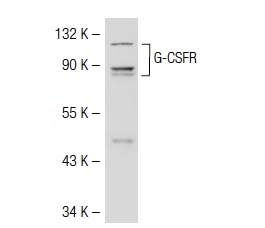
Western blot analysis of G-CSFR expression in M1 whole cell lysate.Application
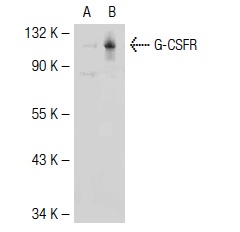
Western blot analysis of G-CSFR expression in non-transfected: (A) and human G-CSFR transfected: (B) 293T whole cell lysates.| Product Name | G-CSFR Antibody (H-176) |
|---|---|
| Antibody Type | Primary Antibodies |
| Modification Notes | The diverse biological activities of G-CSF are initiated by the binding of G-CSF to a specific receptor (G-CSFR) that belongs to the cytokine/hematopoietic receptor superfamily. In contrast to the majority of hematopoietic receptors that are activated through the formation of heteromeric complexes composed of å, ß and sometimes g subunits, G-CSFR proteins are believed to form homodimeric complexes upon ligand binding. Four distinct alternative splice variants of G-CSFR have been described, one of which exists as a soluble receptor protein. Although G-CSFR lacks consensus motifs in its cytoplasmic domains that are characteristic of kinase activities, certain sequences have been identified that are conserved among several members of the cytokine receptor superfamily. For example, the carboxy terminal regions of G-CSFR contain a domain, designated box 3, that is only shared with the IL-6R subunit, gp130. |
| Clonality | Polyclonal |
|---|---|
| Isotype | IgG |
| Host Species | Rabbit |
| Tested Applications | WBIPIFELISA |
| recommended for detection of G-CSFR of mouse, rat and human origin by WB, IP, IF and ELISA | |
| Species Reactivity | HumanMouseRat |
| Concentration | 1mg/ml |
| Purification | Affinity purified |
| Alternative Names | epitope corresponding to amino acids 25-200 mapping near the N-terminus of G-CSFR of human origin |
|---|---|
| Tissue Specificity | epitope corresponding to amino acids 25-200 mapping near the N-terminus of G-CSFR of human origin |
| Entrez Gene | 1441 |
|---|
Application
Western blot analysis of G-CSFR expression in M1 whole cell lysate.
Application
Western blot analysis of G-CSFR expression in non-transfected: (A) and human G-CSFR transfected: (B) 293T whole cell lysates.| Application Notes | recommended for detection of G-CSFR of mouse, rat and human origin by WB, IP, IF and ELISA |
|---|
| Form | Liquid |
|---|---|
| Storage Instructions | For short-term storage, store at 4° C. For long-term storage, aliquot and store at -20ºC or below. Avoid multiple freeze-thaw cycles. |
| Storage Buffer | phosphate buffered saline , pH 7.4, 150mM NaCl, 0.02% sodium azide and 50% glycerol. |


