Application
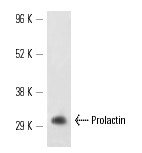
Western blot analysis of human recombinant Prolactin.| Product Name | Prolactin Antibody (H-105) |
|---|---|
| Antibody Type | Primary Antibodies |
| Modification Notes | The anterior pituitary secretes a variety of hormones that are involved in cell growth, differentiation and development. Prolactin, a 226 amino acid protein, plays a role in multiple processes, including cell growth, reproduction and immune function. Full-length Prolactin, as well as an alternative splice product lacking the third exon, are secreted by endothelial cells involved in angiogenesis. In addition to its role in mammary developmant and lactation, Prolactin is known to play a role in the development of mammary cancer, acting as both a mitogen and a differentiating agent. Prolactin has also been shown to enhance the proliferation of B cell hybridomas, leading to an overall increase in antibody production. In addition, Prolactin has been demonstrated to reverse the antiproliferative effects of the immunosuppressive cytokine TGF-beta. Prolactin is also associated with a variety of autoimmune diseases, including arthritis and type 1 diabetes. |
| Clonality | Polyclonal |
|---|---|
| Isotype | IgG |
| Host Species | Rabbit |
| Tested Applications | WBIPIFELISA |
| recommended for detection of Prolactin of human origin by WB, IP, IF and ELISA | |
| Species Reactivity | HumanMouseRat |
| Concentration | 1mg/ml |
| Purification | Affinity purified |
| Alternative Names | epitope corresponding to amino acids 96-200 of Prolactin of human origin |
|---|---|
| Tissue Specificity | epitope corresponding to amino acids 96-200 of Prolactin of human origin |
| Entrez Gene | 5617 |
|---|
Application
Western blot analysis of human recombinant Prolactin.| Application Notes | recommended for detection of Prolactin of human origin by WB, IP, IF and ELISA |
|---|
| Form | Liquid |
|---|---|
| Storage Instructions | For short-term storage, store at 4° C. For long-term storage, aliquot and store at -20ºC or below. Avoid multiple freeze-thaw cycles. |
| Storage Buffer | phosphate buffered saline , pH 7.4, 150mM NaCl, 0.02% sodium azide and 50% glycerol. |


