Application
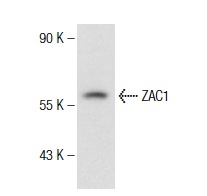
Western blot analysis of ZAC1 expression in GH3 whole cell lysate.| Product Name | ZAC1 Antibody (M-300) |
|---|---|
| Antibody Type | Primary Antibodies |
| Modification Notes | Pleiomorphic adenoma gene (PLAG1) encodes a zinc finger protein and is the target gene for pleiomorphic adenomas of the salivary gland. The PLAG family of zinc finger proteins include PLAG1, ZAC1 and PLAG-like 2 (PLAGL2). ZAC1, also known as PLAGL1, concomitantly controls apoptosis and cell cycle arrest through separate pathways. ZAC1 also acts as a positive or negative transcriptional cofactor for nuclear receptors, depending on the expression of functional p53. ZAC1 is broadly expressed in embryo, with highest expression in the liver primordium, the umbilical region and the neural tube. PLAGL1 is also expressed in normal mammary gland. PLAGL2 functions as a positive regulator of transcription and localizes to the nucleus. PLAGL2 and ZAC1 bind to the DNA consensus sequence ACGGGGGCCCCTTTA. PLAGL2 is ubiquitously expressed with particular abundance in spleen, lung and testis, where it may be involved in cell cycle arrest and apoptosis of tumor cells. |
| Clonality | Polyclonal |
|---|---|
| Isotype | IgG |
| Host Species | Rabbit |
| Tested Applications | WBIPIFELISAGSChIP |
| recommended for detection of ZAC1 of mouse and rat origin by WB, IP, IF and ELISA | |
| Species Reactivity | HumanMouseRat |
| Concentration | 1mg/ml |
| Purification | Affinity purified |
| Alternative Names | epitope corresponding to amino acids 211-510 mapping to an internal region of ZAC1 of mouse origin |
|---|---|
| Tissue Specificity | epitope corresponding to amino acids 211-510 mapping to an internal region of ZAC1 of mouse origin |
| Entrez Gene | 22634 |
|---|
Application
Western blot analysis of ZAC1 expression in GH3 whole cell lysate.| Application Notes | recommended for detection of ZAC1 of mouse and rat origin by WB, IP, IF and ELISA |
|---|
| Form | Liquid |
|---|---|
| Storage Instructions | For short-term storage, store at 4° C. For long-term storage, aliquot and store at -20ºC or below. Avoid multiple freeze-thaw cycles. |
| Storage Buffer | phosphate buffered saline , pH 7.4, 150mM NaCl, 0.02% sodium azide and 50% glycerol. |


