Application
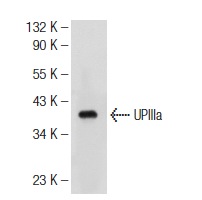
Western blot analysis of UPIIIa expression in LNCaP whole cell lysate.| Product Name | UPIIIa Antibody (H-180) |
|---|---|
| Antibody Type | Primary Antibodies |
| Modification Notes | The asymmetric unit membrane (AUM) forms numerous plaques, which cover the apical surface of the urothelium. These plaques are thought to strengthen the urothelium and reduce the risk of rupturing during ladder distention. They are composed of four major integral membrane proteins called uroplakins (UP). The uroplakin family comprises UPIa, UPIb, UPII, and UPIII. Family members are conserved among several species, including human, mouse, rat, rabbit, dog, pig and sheep. UPIa and UPIb form tightly packed structures with UPII and UPIII, respectively. This pairing is required for normal urothelial plaque formation and is regulated by proteolytic processing of the uroplakin proteins. Uroplakins are expressed in normal urothelium and are used as specific markers of urothelial differentiation. They are also expressed in a majority of transitional cell carcinomas of the bladder (TCCs), which make the uroplakins a useful marker for detecting bladder cancer metastasis and for staging and monitoring chemotherapeutic response. |
| Clonality | Polyclonal |
|---|---|
| Isotype | IgG |
| Host Species | Rabbit |
| Tested Applications | WBIPIFELISA |
| recommended for detection of UPIIIa of mouse, rat and human origin by WB, IP, IF and ELISA also reactive with additional species, including equine, bovine and porcine | |
| Species Reactivity | HumanMouseRat |
| Concentration | 1mg/ml |
| Purification | Affinity purified |
| Alternative Names | epitope corresponding to amino acids 21-200 mapping near the N-terminus of UPIIIa of human origin |
|---|---|
| Tissue Specificity | epitope corresponding to amino acids 21-200 mapping near the N-terminus of UPIIIa of human origin |
| Entrez Gene | 7380 |
|---|
Application
Western blot analysis of UPIIIa expression in LNCaP whole cell lysate.| Application Notes | recommended for detection of UPIIIa of mouse, rat and human origin by WB, IP, IF and ELISA also reactive with additional species, including equine, bovine and porcine |
|---|
| Form | Liquid |
|---|---|
| Storage Instructions | For short-term storage, store at 4° C. For long-term storage, aliquot and store at -20ºC or below. Avoid multiple freeze-thaw cycles. |
| Storage Buffer | phosphate buffered saline , pH 7.4, 150mM NaCl, 0.02% sodium azide and 50% glycerol. |


