
Application
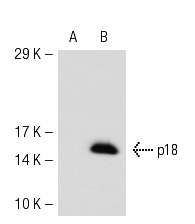
Western blot analysis of p18 expression in non-transfected: (A) and mouse p18 transfected: (B) 293T whole cell lysates.Application
Western blot analysis of p18 expression in NIH/3T3 nuclear extract.| Product Name | p18 Antibody (M-168) |
|---|---|
| Antibody Type | Primary Antibodies |
| Modification Notes | The normal progression of cells through the cell cycle is under the control of the cyclin dependent protein kinases Cdk4 and Cdk6, which are subject to inhibition by the mitotic inhibitory protein p16. Isolated members of the p16 family have been designated p15 and p18. p15 expression is upregulated approximately 30-fold in TGF∫-treated human keratinocytes. The gene encoding p15 has been mapped to chromosome 9p21 at a position adjacent to the p16 gene, at a site of frequent chromosomal abnormality in human tumors. It has been suggested that p15 may function as an effector of TGF∫-mediated cell cycle arrest through inhibition of Cdk4 and Cdk6 kinase. The second p16-related protein, p18, interacts strongly with Cdk6 and to a lesser extent with Cdk4, but lacks apparent interaction with other Cdks. Recombinant p18 has been shown to inhibit cyclin D-Cdk6 kinase activity. In contrast to p21/p27 that form ternary complexes with cyclin-Cdks, only binary complexes of p15, p16 and p18 have been identified in association with Cdk4 and/or Cdk6. |
| Clonality | Polyclonal |
|---|---|
| Isotype | IgG |
| Host Species | Rabbit |
| Tested Applications | WBIPIFELISA |
| recommended for detection of p18 of mouse, rat and human origin by WB, IP, IF and ELISA also reactive with additional species, including equine, canine, bovine and porcine | |
| Species Reactivity | HumanMouseRat |
| Concentration | 1mg/ml |
| Purification | Affinity purified |
| Alternative Names | epitope corresponding to amino acids 1-168 representing full length p18 of mouse origin |
|---|---|
| Tissue Specificity | epitope corresponding to amino acids 1-168 representing full length p18 of mouse origin |
| Entrez Gene | 1031 |
|---|
Application
Western blot analysis of p18 expression in non-transfected: (A) and mouse p18 transfected: (B) 293T whole cell lysates.
Application
Western blot analysis of p18 expression in NIH/3T3 nuclear extract.| Application Notes | recommended for detection of p18 of mouse, rat and human origin by WB, IP, IF and ELISA also reactive with additional species, including equine, canine, bovine and porcine |
|---|
| Form | Liquid |
|---|---|
| Storage Instructions | For short-term storage, store at 4° C. For long-term storage, aliquot and store at -20ºC or below. Avoid multiple freeze-thaw cycles. |
| Storage Buffer | phosphate buffered saline , pH 7.4, 150mM NaCl, 0.02% sodium azide and 50% glycerol. |


