Application
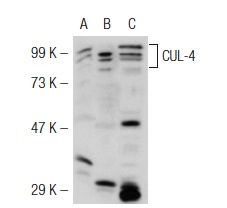
Western blot analysis of CUL-4 expression in non-transfected 293T: (A), mouse CUL-4 transfected 293T: (B) and PC-12 (C) whole cell lysates.Application
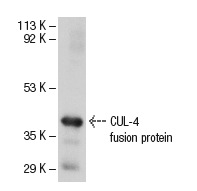
Western blot analysis of human recombinant CUL-4 fusion protein.| Product Name | CUL-4 Antibody (H-66) |
|---|---|
| Antibody Type | Primary Antibodies |
| Modification Notes | Cullin proteins comprise a distinct family of mediators that participate in the selective targeting of proteins for ubiquitin (Ub)-mediated proteolysis. Cul-1, which is the mammalian homolog of Cdc53 from yeast, is an integral component of the E3 ubiquitin ligase complex designated SCF. The SCF (Skp1/Cul-1/F-box protein complex) consists of Skp1 associating with both Cul-1 and an F-box protein, such as Skp2, which determines the substrate specificity of the complex. Cul-1 mediated ubiquitination results in the degradation of cell cycle proteins cyclin D, p21 and cyclin E. Another cullin, CUL-3 facilitates the degradation of cyclin E independent of SCF activity, while CUL-2 associates with the tumor suppressing protein VHL and elongin B to form VBC complexes, which structurally resemble the SCF ligase. Proteolysis also occurs by way of CUL-4 associating with Nedd-8, a ubiquitin-like protein, where it too functions as an active component of a multifunctional E3 complex. CUL-5, or vasopressin-activated, calcium-mobilizing protein (VACM-1), is also included in the cullin family as it shares substantial sequence homology with CUL-1. |
| Clonality | Polyclonal |
|---|---|
| Isotype | IgG |
| Host Species | Rabbit |
| Tested Applications | WBIPIFELISA |
| recommended for detection of CUL-4A and CUL-4B of mouse, rat and human origin by WB, IP, IF and ELISA also reactive with additional species, including equine, canine, bovine, porcine and avian | |
| Species Reactivity | HumanMouseRat |
| Concentration | 1mg/ml |
| Purification | Affinity purified |
| Alternative Names | epitope corresponding to amino acids 536-597 mapping near the C-terminus of cullin-4 (CUL-4) of human origin |
|---|---|
| Tissue Specificity | epitope corresponding to amino acids 536-597 mapping near the C-terminus of cullin-4 (CUL-4) of human origin |
| Entrez Gene | 8450 |
|---|
Application
Western blot analysis of CUL-4 expression in non-transfected 293T: (A), mouse CUL-4 transfected 293T: (B) and PC-12 (C) whole cell lysates.
Application
Western blot analysis of human recombinant CUL-4 fusion protein.| Application Notes | recommended for detection of CUL-4A and CUL-4B of mouse, rat and human origin by WB, IP, IF and ELISA also reactive with additional species, including equine, canine, bovine, porcine and avian |
|---|
| Form | Liquid |
|---|---|
| Storage Instructions | For short-term storage, store at 4° C. For long-term storage, aliquot and store at -20ºC or below. Avoid multiple freeze-thaw cycles. |
| Storage Buffer | phosphate buffered saline , pH 7.4, 150mM NaCl, 0.02% sodium azide and 50% glycerol. |


