Application
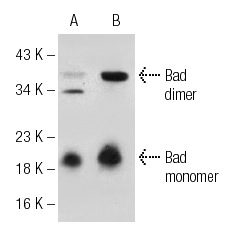
Western blot analysis of Bad expression mouse prostate (A) and mouse kidney (B) tissue extracts.Application
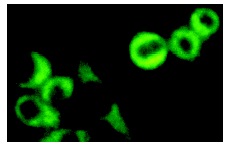
Immunofluorescence staining of methanol-fixed NIH/3T3 cells showing cytoplasmic localization.| Product Name | Bad Antibody (C-20) |
|---|---|
| Antibody Type | Primary Antibodies |
| Modification Notes | The Bcl-2 family of proteins is characterized by its ability to modulate cell death (apoptosis) under a broad range of physiologic conditions. Bcl-2 and several related proteins function to inhibit apoptosis (1,2) while other members of the Bcl-2 family, such as Bax (3,4) and Bak (5,6), enhance cell death under various conditions. For instance, Bcl-xL represses cell death, while its shorter form, Bcl-xS, promotes apoptosis (7). A protein designated Bad exhibits homology to Bcl-2 limited to the BH1 and BH2 domains (8). Bad functions to dimerize with Bcl-xL and with Bcl-2, but not with Bax, Bcl-xS, Mcl-1, A1 or itself. In mammalian cells, Bad binds with greater affinity to Bcl-xL than to Bcl-2 and reverses the death repressor activity of Bcl-xL but not Bcl-2 (8). Dimerization of Bad with Bcl-xL results in displacement of Bax from Bcl-xL:Bax complexes thereby causing restoration of Bax-mediated apoptosis (8). |
| Clonality | Polyclonal |
|---|---|
| Isotype | IgG |
| Host Species | Rabbit |
| Tested Applications | WBIPIFELISA |
| recommended for detection of Bad of mouse and rat origin by WB, IP, IF and ELISA also reactive with additional species, including equine and canine | |
| Species Reactivity | HumanMouseRat |
| Concentration | 1mg/ml |
| Purification | Affinity purified |
| Alternative Names | epitope mapping at the C-terminus of Bad of mouse origin |
|---|---|
| Tissue Specificity | epitope mapping at the C-terminus of Bad of mouse origin |
| Entrez Gene | 12015 |
|---|
Application
Western blot analysis of Bad expression mouse prostate (A) and mouse kidney (B) tissue extracts.
Application
Immunofluorescence staining of methanol-fixed NIH/3T3 cells showing cytoplasmic localization.| Application Notes | recommended for detection of Bad of mouse and rat origin by WB, IP, IF and ELISA also reactive with additional species, including equine and canine |
|---|
| Form | Liquid |
|---|---|
| Storage Instructions | For short-term storage, store at 4° C. For long-term storage, aliquot and store at -20ºC or below. Avoid multiple freeze-thaw cycles. |
| Storage Buffer | phosphate buffered saline , pH 7.4, 150mM NaCl, 0.02% sodium azide and 50% glycerol. |


