Application
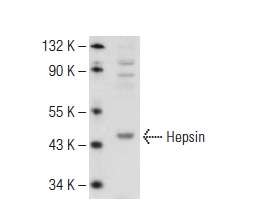
Western blot analysis of Hepsin expression in NIH/3T3 whole cell lysate.Application
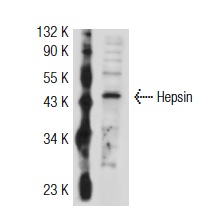
Western blot analysis of Hepsin expression in WEHI-231 whole cell lysate.| Product Name | Hepsin Antibody (M-55) |
|---|---|
| Antibody Type | Primary Antibodies |
| Modification Notes | Extracellular proteases mediate the digestion of neighboring extracellular matrix components in initial tumor growth, allow desquamation of tumor cells into the surrounding environment, provide the basis for invasion of basement membranes in targeted metastatic organs and are required for release and activation of many growth and angiogenic factors. Hepsin (also known as TMPRSS1) is a type II transmembrane serine protease in mammalian cells that is highly expressed on the surface of hepatocytes. Hepsin is frequently overexpressed in several tumors, suggesting that it is a candidate protease in the invasive process and growth capacity of tumor cells. The basal promoter region of the Hepsin gene contains potential binding sites for SP1, AP2, C/EBP, LF-A1 and E box, which may be responsible for the ubiquitous expression of the protein, which shows preferential expression in liver and kidney. Hepsin is located at the plasma membrane, with its catalytic subunit (C-terminal half) at the cell surface and its N-terminus facing the cytosol. Hepsin has been shown to play a role in normal cell growth, embryogenesis, hepatocyte growth, blood coagulation and fertilization. In addition, Hepsin converts zymogen Factor VII to Factor VIIa, which is capable of initiating a coagulation pathway on the cell surface and ultimately leads to Thrombin formation. |
| Clonality | Polyclonal |
|---|---|
| Isotype | IgG |
| Host Species | Rabbit |
| Tested Applications | WBIPIFELISA |
| recommended for detection of Hepsin catalytic chain of mouse, rat and human origin by WB, IP, IF and ELISA also reactive with additional species, including canine, bovine and porcine | |
| Species Reactivity | HumanMouseRat |
| Concentration | 1mg/ml |
| Purification | Affinity purified |
| Alternative Names | epitope corresponding to amino acids 221-275 mapping within an internal region of Hepsin of mouse origin |
|---|---|
| Tissue Specificity | epitope corresponding to amino acids 221-275 mapping within an internal region of Hepsin of mouse origin |
| Entrez Gene | 3249 |
|---|
Application
Western blot analysis of Hepsin expression in NIH/3T3 whole cell lysate.
Application
Western blot analysis of Hepsin expression in WEHI-231 whole cell lysate.| Application Notes | recommended for detection of Hepsin catalytic chain of mouse, rat and human origin by WB, IP, IF and ELISA also reactive with additional species, including canine, bovine and porcine |
|---|
| Form | Liquid |
|---|---|
| Storage Instructions | For short-term storage, store at 4° C. For long-term storage, aliquot and store at -20ºC or below. Avoid multiple freeze-thaw cycles. |
| Storage Buffer | phosphate buffered saline , pH 7.4, 150mM NaCl, 0.02% sodium azide and 50% glycerol. |


