Application
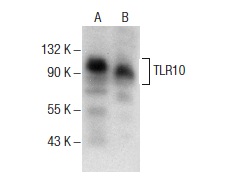
Western blot analysis of TLR10 expression in NIH/3T3 (A) and RAW 264.7 (B) whole cell lysates.| Product Name | TLR10 Antibody (H-165) |
|---|---|
| Antibody Type | Primary Antibodies |
| Modification Notes | The Toll-like Receptors (TLR) are a family of human receptors that share homology with the Drosophila Toll Receptors, which are involved in mediating dorsoventral polarization in developing Drosophila embryos and participate in host immunity. The TLR family members are characterized by a highly conserved Toll homology (TH) domain, which is essential for Toll-induced signal transductions. TLR’s are type I transmembrane receptors that contain an extracellular domain consisting of several leucine-rich regions and a single cytoplasmic Toll/IL-1R like domain. TLR6 is highly homologous to TLR1, sharing greater that 65% sequence identity, and, like other members of TLR family, it induces NFkB signaling upon activation. TLR10 is also most closely related to TLR1 and TLR6, with 50% and 49% overall homology, respectively. TLR10 is predominantly expressed in tissues and cells involved in the immune response, including spleen, lymph node, thymus and tonsil. |
| Clonality | Polyclonal |
|---|---|
| Isotype | IgG |
| Host Species | Rabbit |
| Tested Applications | WBIPIFELISA |
| recommended for detection of TLR10 of mouse, rat and human origin by WB, IP, IF and ELISA | |
| Species Reactivity | HumanMouseRat |
| Concentration | 1mg/ml |
| Purification | Affinity purified |
| Alternative Names | epitope corresponding to amino acids 271-435 mapping within an extracellular domain of TLR10 of human origin |
|---|---|
| Tissue Specificity | epitope corresponding to amino acids 271-435 mapping within an extracellular domain of TLR10 of human origin |
| Entrez Gene | 81793 |
|---|
Application
Western blot analysis of TLR10 expression in NIH/3T3 (A) and RAW 264.7 (B) whole cell lysates.| Application Notes | recommended for detection of TLR10 of mouse, rat and human origin by WB, IP, IF and ELISA |
|---|
| Form | Liquid |
|---|---|
| Storage Instructions | For short-term storage, store at 4° C. For long-term storage, aliquot and store at -20ºC or below. Avoid multiple freeze-thaw cycles. |
| Storage Buffer | phosphate buffered saline , pH 7.4, 150mM NaCl, 0.02% sodium azide and 50% glycerol. |


