Application
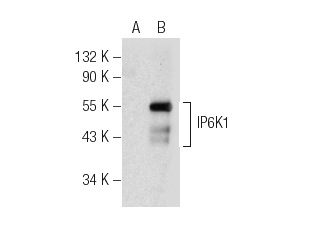
Western blot analysis of IP6K1 expression in non-transfected: (A) and human IP6K1 transfected: (B) 293 whole cell lysates.| Product Name | IP6K1 Antibody (H-130) |
|---|---|
| Antibody Type | Primary Antibodies |
| Modification Notes | The members of the inositol hexakisphosphate kinase family, IP6K1 and IP6K2, have a high affinity and selectivity for inositol hexakisphosphate (InsP6) as a substrate. IP6K1 and IP6K2 (also designated PiUS) convert InsP6 to PP-InsP5. However, neither kinase demonstrates any catalytic activity with other inositol pyrophosphates. The presence of InsP6, which inhibits serine/threonine protein phosphatases, increases the influx of calcium across the plasma membrane and implies that it may mediate the regulation of insulin exocytosis. IP6K1 was purified in rat brain extracts. By homology, IP6K1 and IP6K2 were characterized in mouse. IP6K1 displays ATP synthase activity by transferring a phosphate from PP-InsP5 to ADP, which suggests a role for the IP6 kinases as high energy phosphate donors. |
| Clonality | Polyclonal |
|---|---|
| Isotype | IgG |
| Host Species | Rabbit |
| Tested Applications | WBIPIFELISA |
| recommended for detection of IP6K1 of mouse, rat and human origin by WB, IP, IF and ELISA also reactive with additional species, including equine, canine, bovine and porcine | |
| Species Reactivity | HumanMouseRat |
| Concentration | 1mg/ml |
| Purification | Affinity purified |
| Alternative Names | epitope corresponding to amino acids 77-206 mapping near the N-terminus of IP6K1 of human origin |
|---|---|
| Tissue Specificity | epitope corresponding to amino acids 77-206 mapping near the N-terminus of IP6K1 of human origin |
| Entrez Gene | 9807 |
|---|
Application
Western blot analysis of IP6K1 expression in non-transfected: (A) and human IP6K1 transfected: (B) 293 whole cell lysates.| Application Notes | recommended for detection of IP6K1 of mouse, rat and human origin by WB, IP, IF and ELISA also reactive with additional species, including equine, canine, bovine and porcine |
|---|
| Form | Liquid |
|---|---|
| Storage Instructions | For short-term storage, store at 4° C. For long-term storage, aliquot and store at -20ºC or below. Avoid multiple freeze-thaw cycles. |
| Storage Buffer | phosphate buffered saline , pH 7.4, 150mM NaCl, 0.02% sodium azide and 50% glycerol. |


