Application
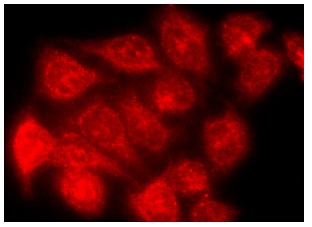
Immunofluorescence staining of methanol-fixed HeLa cells showing membrane localization.Application
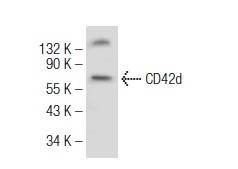
Western blot analysis of CD42d expression in Daudi whole cell lysate.| Product Name | CD42d Antibody (H-300) |
|---|---|
| Antibody Type | Primary Antibodies |
| Modification Notes | In the early phase of primary hemostasis, platelets adhere to damaged blood vessel walls by binding via the CD42 complex, also designated platelet glycoprotein (GP) complex, to the von Willebrand factor (vWf) protein, which is exposed on the subendothelium (1-3). The CD42 complex contains four subunits, CD42b (GPIb alpha) and CD42c (GPIb beta), which are linked by a disulfide bridge, and CD42a (GPIX) and CD42d (GPV), which are noncovalently linked to the complex (1-4). The CD42 complex is specifically expressed in platelets and megakaryocytes (5). Cleavage of CD42d by thrombin produces a soluble fragment and a membrane associated fragment, which merits CD42d as a useful marker for platelet activation by thrombin (7). The gene encoding human CD42d maps to chromosome 3q29 (8). |
| Clonality | Polyclonal |
|---|---|
| Isotype | IgG |
| Host Species | Rabbit |
| Tested Applications | WBIPIFELISA |
| recommended for detection of CD42d of mouse, rat and human origin by WB, IP, IF and ELISA also reactive with additional species, including equine | |
| Species Reactivity | HumanMouseRat |
| Concentration | 1mg/ml |
| Purification | Affinity purified |
| Alternative Names | epitope corresponding to amino acids 17-316 mapping within an extracellular domain of CD42d of human origin |
|---|---|
| Tissue Specificity | epitope corresponding to amino acids 17-316 mapping within an extracellular domain of CD42d of human origin |
| Entrez Gene | 2814 |
|---|
Application
Immunofluorescence staining of methanol-fixed HeLa cells showing membrane localization.
Application
Western blot analysis of CD42d expression in Daudi whole cell lysate.| Application Notes | recommended for detection of CD42d of mouse, rat and human origin by WB, IP, IF and ELISA also reactive with additional species, including equine |
|---|
| Form | Liquid |
|---|---|
| Storage Instructions | For short-term storage, store at 4° C. For long-term storage, aliquot and store at -20ºC or below. Avoid multiple freeze-thaw cycles. |
| Storage Buffer | phosphate buffered saline , pH 7.4, 150mM NaCl, 0.02% sodium azide and 50% glycerol. |


