Application
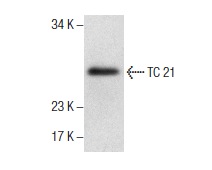
Western blot analysis of TC 21 expression in mouse brain tissue extract.| Product Name | TC 21 Antibody (H-45) |
|---|---|
| Antibody Type | Primary Antibodies |
| Modification Notes | H-, K- and N-Ras represent the prototype members of a family of small G proteins that are frequently activated to an oncogenic state in a wide variety of human tumors. Activation is due to point mutations at either position 12 or 61 within their coding sequence. Such mutations cause these proteins to be constitutively converted to their active GTP-bound, rather than the inactive GDP-bound, state. The related human R-Ras gene was initially cloned by low stringency hybridization methods. Position 38 and 87 (analogous to position 12 and 61 in H-Ras) mutants of R-Ras have been shown to be capable of activating oncogenic function. An additional member of the Ras oncogene family, designated TC 21 (or R-Ras-2) is most closely related to R-Ras. While wild type TC 21 does not exhibit transforming potential in vitro, mutant forms of TC 21 that possess amino acid substitutions analogous to those that activate Ras oncogenic potential, exhibit potent transforming activities comparable to the activity characteristic of the known oncogenic Ras proteins. |
| Clonality | Polyclonal |
|---|---|
| Isotype | IgG |
| Host Species | Rabbit |
| Tested Applications | WBIPIFELISA |
| recommended for detection of TC 21 of mouse, rat and human origin by WB, IP, IF and ELISA also reactive with additional species, including equine, canine, bovine and avian | |
| Species Reactivity | HumanMouseRat |
| Concentration | 1mg/ml |
| Purification | Affinity purified |
| Alternative Names | epitope corresponding to amino acids 137-181 mapping near the C-terminus of TC 21 of human origin |
|---|---|
| Tissue Specificity | epitope corresponding to amino acids 137-181 mapping near the C-terminus of TC 21 of human origin |
| Entrez Gene | 22800 |
|---|
Application
Western blot analysis of TC 21 expression in mouse brain tissue extract.| Application Notes | recommended for detection of TC 21 of mouse, rat and human origin by WB, IP, IF and ELISA also reactive with additional species, including equine, canine, bovine and avian |
|---|
| Form | Liquid |
|---|---|
| Storage Instructions | For short-term storage, store at 4° C. For long-term storage, aliquot and store at -20ºC or below. Avoid multiple freeze-thaw cycles. |
| Storage Buffer | phosphate buffered saline , pH 7.4, 150mM NaCl, 0.02% sodium azide and 50% glycerol. |


