Application
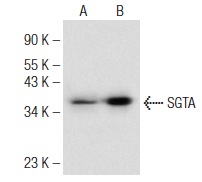
Western blot analysis of SGTA expression in HeLa (A) and K-562 (B) whole cell lysates.| Product Name | SGTA Antibody (H-80) |
|---|---|
| Antibody Type | Primary Antibodies |
| Modification Notes | SGTA (small glutamine-rich tetratricopeptide repeat (TPR)-containing protein A or alpha), also known as SGT, hSGT or UBP (Vpu-binding protein), is a ubiquitously expressed protein that contains three TPR protein-protein interaction repeats. SGTA is believed to function as a component of the androgen receptor (AR)-chaperone-co-chaperone complex, acting as a co-chaperone involved in androgen signaling. More specifically, SGTA binds to the hinge region of the AR functions to retain the AR in the cytoplasm, thereby inhibiting androgen signaling. In addition, SGTA functions as a co-chaperone for HSP 90 and HSP 70, two proteins known to participate in apoptosis. On the basis of its role in apoptosis and androgen signaling, SGTA is a potential candidate for PCOS (polycystic ovary syndrome), a disorder characterized by androgen excess, obesity and menstrual disturbances. SGTA also interacts with the nonstructural Parvovirus protein NS1 and the HIV-1 proteins Vpu and Gag. |
| Clonality | Polyclonal |
|---|---|
| Isotype | IgG |
| Host Species | Rabbit |
| Tested Applications | WBIPIFELISA |
| recommended for detection of SGTA of mouse, rat and human origin by WB, IP, IF and ELISA also reactive with additional species, including equine, canine, bovine and porcine | |
| Species Reactivity | HumanMouseRat |
| Concentration | 1mg/ml |
| Purification | Affinity purified |
| Alternative Names | epitope corresponding to amino acids 41-120 mapping near the N-terminus of SGTA of human origin |
|---|---|
| Tissue Specificity | epitope corresponding to amino acids 41-120 mapping near the N-terminus of SGTA of human origin |
| Entrez Gene | 6449 |
|---|
Application
Western blot analysis of SGTA expression in HeLa (A) and K-562 (B) whole cell lysates.| Application Notes | recommended for detection of SGTA of mouse, rat and human origin by WB, IP, IF and ELISA also reactive with additional species, including equine, canine, bovine and porcine |
|---|
| Form | Liquid |
|---|---|
| Storage Instructions | For short-term storage, store at 4° C. For long-term storage, aliquot and store at -20ºC or below. Avoid multiple freeze-thaw cycles. |
| Storage Buffer | phosphate buffered saline , pH 7.4, 150mM NaCl, 0.02% sodium azide and 50% glycerol. |


