Application
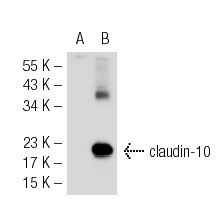
Western blot analysis of claudin-10 expression in non-transfected: (A) and mouse claudin-10 transfected: (B) 293T whole cell lysates.| Product Name | claudin-10 Antibody (H-58) |
|---|---|
| Antibody Type | Primary Antibodies |
| Modification Notes | The claudin superfamily consists of many structurally related proteins in humans. These proteins are important structural and functional components of tight junctions in paracellular transport. Claudins are located in both epithelial and endothelial cells in all tight junction-bearing tissues. Three classes of proteins are known to localize to tight junctions, including the claudins, Occludin and junction adhesion molecules. Claudins, which consist of four transmembrane domains and two extracellular loops, make up tight junction strands. Claudin expression is often highly restricted to specfic regions of different tissues and may have an important role in transcellular transport through tight junctions. Claudin-10 is a 228 amino acid multi-pass membrane protein that belongs to the claudin family and plays an important role in cell-adhesion activity and tight junction-specific events. |
| Clonality | Polyclonal |
|---|---|
| Isotype | IgG |
| Host Species | Rabbit |
| Tested Applications | WBIPIFELISA |
| recommended for detection of claudin-10 of mouse, rat and human origin by WB, IP, IF and ELISA also reactive with additional species, including equine, canine, bovine and porcine | |
| Species Reactivity | HumanMouseRat |
| Concentration | 1mg/ml |
| Purification | Affinity purified |
| Alternative Names | epitope corresponding to amino acids 171-228 mapping at the C-terminus of claudin-10 of human origin |
|---|---|
| Tissue Specificity | epitope corresponding to amino acids 171-228 mapping at the C-terminus of claudin-10 of human origin |
| Entrez Gene | 9071 |
|---|
Application
Western blot analysis of claudin-10 expression in non-transfected: (A) and mouse claudin-10 transfected: (B) 293T whole cell lysates.| Application Notes | recommended for detection of claudin-10 of mouse, rat and human origin by WB, IP, IF and ELISA also reactive with additional species, including equine, canine, bovine and porcine |
|---|
| Form | Liquid |
|---|---|
| Storage Instructions | For short-term storage, store at 4° C. For long-term storage, aliquot and store at -20ºC or below. Avoid multiple freeze-thaw cycles. |
| Storage Buffer | phosphate buffered saline , pH 7.4, 150mM NaCl, 0.02% sodium azide and 50% glycerol. |


