Application
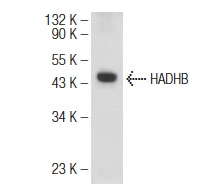
Western blot analysis of HADHB expression in Jurkat whole cell lysate.| Product Name | HADHB Antibody (H-290) |
|---|---|
| Antibody Type | Primary Antibodies |
| Modification Notes | HADHB (Trifunctional enzyme subunit beta (mitochondrial), Acetyl-CoA acyltransferase) is a 474 amino acid protein encoded by the human gene HADHB. HADHB belong to the thiolase family, which are ubiquitous enzymes that catalyze the reversible thiolytic cleavage of 3-ketoacyl-CoA into acyl-CoA and acetyl-CoA, a 2-step reaction involving a covalent intermediate formed with a catalytic cysteine. HADHB is found in the mitochondrion as an octamer of 4 a (HADHA) and 4 b (HADHB) subunits. Defects in HADHB are a cause of trifunctional protein deficiency (TFP deficiency). The clinical manifestations are very variable and include hypoglycemia, cardiomyopathy and sudden death. Phenotypes with mainly hepatic and neuromyopathic involvement can also be distinguished. Biochemically, TFP deficiency is defined by the loss of all three enzyme activities of the TFP complex. |
| Clonality | Polyclonal |
|---|---|
| Isotype | IgG |
| Host Species | Rabbit |
| Tested Applications | WBIPIFELISA |
| recommended for detection of HADHB of mouse, rat and human origin by WB, IP, IF and ELISA also reactive with additional species, including equine, canine and bovine | |
| Species Reactivity | HumanMouseRat |
| Concentration | 1mg/ml |
| Purification | Affinity purified |
| Alternative Names | epitope corresponding to amino acids 1-290 mapping at the N-terminus of HADHB of human origin |
|---|---|
| Tissue Specificity | epitope corresponding to amino acids 1-290 mapping at the N-terminus of HADHB of human origin |
| Entrez Gene | 3032 |
|---|
Application
Western blot analysis of HADHB expression in Jurkat whole cell lysate.| Application Notes | recommended for detection of HADHB of mouse, rat and human origin by WB, IP, IF and ELISA also reactive with additional species, including equine, canine and bovine |
|---|
| Form | Liquid |
|---|---|
| Storage Instructions | For short-term storage, store at 4° C. For long-term storage, aliquot and store at -20ºC or below. Avoid multiple freeze-thaw cycles. |
| Storage Buffer | phosphate buffered saline , pH 7.4, 150mM NaCl, 0.02% sodium azide and 50% glycerol. |


