Application
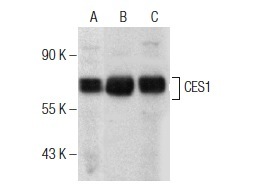
Western blot analysis of CES1 expression in rat PBL whole cell lysate (A) and rat adrenal gland (B) and rat liver (C) tissue extracts.| Product Name | CES1 Antibody (R-40) |
|---|---|
| Antibody Type | Primary Antibodies |
| Modification Notes | CES1 and CES2 are the two major liver carboxylesterases which belong to the type-B carboxylesterase/lipase family. Helping the body in the detoxification of a wide range of xenobiotics, CES1 and CES2 are involved in the hydrolyzing activation of therapeutic ester and amide pro-drugs, as well as in the detoxification of several narcotic compounds. The catalytic activity of CES1 and CES2 is influenced by both the esterification site and the structure/moiety of the amino acid. While CES1 shows high affinity for aromatic and aliphatic esters, CES2 shows high affinity for 3,6-diacetyl and 6-monoacetly esters, such as those found in morphine and morphine derivatives. Since CES1 and CES2 are crucial in the breakdown of various foreign molecules, several therapeutic compounds, such as anti-tumor agents, are structurally designed to target the catalytic sites of one or both of these key carboxylesterase proteins. |
| Clonality | Polyclonal |
|---|---|
| Isotype | IgG |
| Host Species | Rabbit |
| Tested Applications | WBIPIFELISA |
| recommended for detection of CES1 of rat origin by WB, IP, IF and ELISA | |
| Species Reactivity | HumanMouseRat |
| Concentration | 1mg/ml |
| Purification | Affinity purified |
| Alternative Names | epitope corresponding to amino acids 351-390 mapping within an internal region of CES1 of rat origin |
|---|---|
| Tissue Specificity | epitope corresponding to amino acids 351-390 mapping within an internal region of CES1 of rat origin |
Application
Western blot analysis of CES1 expression in rat PBL whole cell lysate (A) and rat adrenal gland (B) and rat liver (C) tissue extracts.| Application Notes | recommended for detection of CES1 of rat origin by WB, IP, IF and ELISA |
|---|
| Form | Liquid |
|---|---|
| Storage Instructions | For short-term storage, store at 4° C. For long-term storage, aliquot and store at -20ºC or below. Avoid multiple freeze-thaw cycles. |
| Storage Buffer | phosphate buffered saline , pH 7.4, 150mM NaCl, 0.02% sodium azide and 50% glycerol. |


