Application
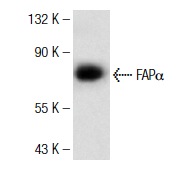
Western blot analysis of FAPα expression in mouse skin tissue extract.WB
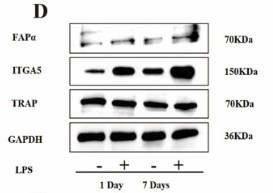
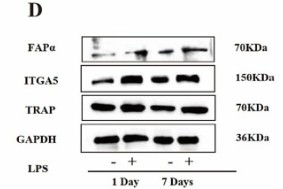
(D) Western blot analysis results.WB
(D) Protein expression of FAPα, ITGA5, and TRAP after 1 or 7 days of LPS treatment.| Product Name | FAPα Antibody (H-56) |
|---|---|
| Antibody Type | Primary Antibodies |
| Modification Notes | FAPa, or Seprase, is a 760 amino acid protein encoded by the human gene FAP and belongs to the peptidase S9B family. FAPa may have a role in tissue remodeling during development and wound healing so it is possible FAPa may contribute to invasiveness of malignant cancers. It degrades gelatin and heat-denatured type I and type IV collagen, but not native type I or type IV collagen. It also does not cleave laminin, fibronectin, fibrin or casein. FAPa is a single-pass type II membrane protein found on cell surface lamellipodia, invadopodia and on shed vesicles. FAPa is usually found as a glycosylated homodimer, or heterodimer with DPP4. The FAPa monomer is an inactive form. |
| Clonality | Polyclonal |
|---|---|
| Isotype | IgG |
| Host Species | Rabbit |
| Tested Applications | ELISAIFIPWB |
| recommended for detection of FAPα of mouse, rat and human origin by WB, IP, IF and ELISA also reactive with additional species, including equine, canine, bovine and porcine | |
| Species Reactivity | HumanMouseRat |
| Concentration | 1mg/ml |
| Purification | Affinity purified |
| Alternative Names | epitope corresponding to amino acids 544-599 mapping near the C-terminus of FAPα of human origin |
|---|---|
| Tissue Specificity | epitope corresponding to amino acids 544-599 mapping near the C-terminus of FAPα of human origin |
| Entrez Gene | 2191 |
|---|
Application
Western blot analysis of FAPα expression in mouse skin tissue extract.
WB
(D) Western blot analysis results.
WB
(D) Protein expression of FAPα, ITGA5, and TRAP after 1 or 7 days of LPS treatment.| Application Notes | recommended for detection of FAPα of mouse, rat and human origin by WB, IP, IF and ELISA also reactive with additional species, including equine, canine, bovine and porcine |
|---|
| Form | Liquid |
|---|---|
| Storage Instructions | For short-term storage, store at 4° C. For long-term storage, aliquot and store at -20ºC or below. Avoid multiple freeze-thaw cycles. |
| Storage Buffer | phosphate buffered saline , pH 7.4, 150mM NaCl, 0.02% sodium azide and 50% glycerol. |


