Application
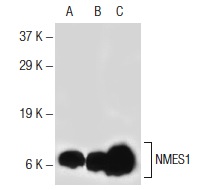
Western blot analysis of NMES1 expression in NRK (A) and KNRK (B) whole cell lysates and rat testis tissue extract (C).Application
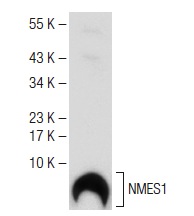
Western blot analysis of NMES1 expression in KNRK whole cell lysate.| Product Name | NMES1 Antibody (M-14) |
|---|---|
| Antibody Type | Primary Antibodies |
| Modification Notes | Encoding more than 700 genes, chromosome 15 is made up of approximately 106 million base pairs and is about 3% of the human genome. Angelman and Prader-Willi syndromes are associated with loss of function or deletion of genes in the 15q11-q13 region. In the case of Angelman syndrome, this loss is due to inactivity of the maternal 15q11-q13 encoded UBE3A gene in the brain by either chromosomal deletion or mutation. In cases of Prader-Willi syndrome, there is a partial or complete deletion of this region from the paternal copy of chromosome 15. Tay-Sachs disease is a lethal disorder associated with mutations of the HEXA gene, which is encoded by chromosome 15. Marfan syndrome is associated with chromosome 15 through the FBN1 gene. |
| Clonality | Polyclonal |
|---|---|
| Isotype | IgG |
| Host Species | Rabbit |
| Tested Applications | WBIPIFELISA |
| recommended for detection of NMES1 of mouse and rat origin by WB, IP, IF and ELISA also reactive with additional species, including equine | |
| Species Reactivity | HumanMouseRat |
| Concentration | 1mg/ml |
| Purification | Affinity purified |
| Alternative Names | epitope mapping near the C-terminus of NMES1 of mouse origin |
|---|---|
| Tissue Specificity | epitope mapping near the C-terminus of NMES1 of mouse origin |
Application
Western blot analysis of NMES1 expression in NRK (A) and KNRK (B) whole cell lysates and rat testis tissue extract (C).
Application
Western blot analysis of NMES1 expression in KNRK whole cell lysate.| Application Notes | recommended for detection of NMES1 of mouse and rat origin by WB, IP, IF and ELISA also reactive with additional species, including equine |
|---|
| Form | Liquid |
|---|---|
| Storage Instructions | For short-term storage, store at 4° C. For long-term storage, aliquot and store at -20ºC or below. Avoid multiple freeze-thaw cycles. |
| Storage Buffer | phosphate buffered saline , pH 7.4, 150mM NaCl, 0.02% sodium azide and 50% glycerol. |


