Application
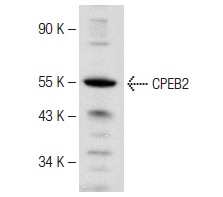
Western blot analysis of CPEB2 expression in WI 38 whole cell lysate.| Product Name | CPEB2 Antibody (H-40) |
|---|---|
| Antibody Type | Primary Antibodies |
| Modification Notes | The regulated translation of messenger RNA is essential for cell-cycle progression, establishment of the body plan during early development and modulation of key activities in the central nervous system. Cytoplasmic polyadenylation, one mechanism of controlling translation, is driven by cytoplasmic polyadenylation element binding proteins, called CPEBs. CPEB2 is highly similar to CPEB, a conserved, sequence-specific RNA-binding protein that binds to the cytoplasmic polyadenylation element, thereby modulating translational repression and mRNA localization. Expressed in a variety of tissues with abundant expression observed in the testis, CPEB2 is thought to regulate mRNA expression of previously inactive spermatids during spermiogenesis. CPEB2 binds to poly (U) mRNA oligomers and contains two RNA recognition motif domains. |
| Clonality | Polyclonal |
|---|---|
| Isotype | IgG |
| Host Species | Rabbit |
| Tested Applications | WBIPIFELISA |
| recommended for detection of CPEB2 of mouse, rat and human origin by WB, IP, IF and ELISA | |
| Species Reactivity | HumanMouseRat |
| Concentration | 1mg/ml |
| Purification | Affinity purified |
| Alternative Names | epitope corresponding to amino acids 106-145 mapping within an internal region of CPEB2 of human origin |
|---|---|
| Tissue Specificity | epitope corresponding to amino acids 106-145 mapping within an internal region of CPEB2 of human origin |
Application
Western blot analysis of CPEB2 expression in WI 38 whole cell lysate.| Application Notes | recommended for detection of CPEB2 of mouse, rat and human origin by WB, IP, IF and ELISA |
|---|
| Form | Liquid |
|---|---|
| Storage Instructions | For short-term storage, store at 4° C. For long-term storage, aliquot and store at -20ºC or below. Avoid multiple freeze-thaw cycles. |
| Storage Buffer | phosphate buffered saline , pH 7.4, 150mM NaCl, 0.02% sodium azide and 50% glycerol. |


