Application
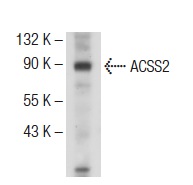
Western blot analysis of ACSS2 expression in mouse liver tissue extract.| Product Name | ACSS2 Antibody (G-17) |
|---|---|
| Antibody Type | Primary Antibodies |
| Modification Notes | ACSS2 (acyl-CoA synthetase short-chain family member 2), also known as ACAS2, ACS, ACSA or AceCS, is a 701 amino acid cytoplasmic protein that belongs to the ATP-dependent AMP-binding enzyme family. Existing as a monomer, ACSS2 functions to catalyze the ATP-dependent activation of acetate, a reaction that yields acetyl-CoA for use in energy generation and lipid synthesis. ACSS2 expression, which is highest in liver and kidney tissue, is regulated by the presence of unsaturated fatty acids and sterol regulatory element-binding proteins (SREBPs). Human ACSS2 exists as two alternatively spliced isoforms and shares 93% sequence identity with its mouse counterpart, suggesting a conserved role between species. |
| Clonality | Polyclonal |
|---|---|
| Isotype | IgG |
| Host Species | Rabbit |
| Tested Applications | WBIPIFELISA |
| recommended for detection of ACSS2 of mouse, rat and human origin by WB, IP, IF and ELISA non cross-reactive with ACSS1 also reactive with additional species, including equine and canine | |
| Species Reactivity | HumanMouseRat |
| Concentration | 1mg/ml |
| Purification | Affinity purified |
| Alternative Names | epitope mapping within an internal region of ACSS2 of human origin |
|---|---|
| Tissue Specificity | epitope mapping within an internal region of ACSS2 of human origin |
| Entrez Gene | 55902 |
|---|
Application
Western blot analysis of ACSS2 expression in mouse liver tissue extract.| Application Notes | recommended for detection of ACSS2 of mouse, rat and human origin by WB, IP, IF and ELISA non cross-reactive with ACSS1 also reactive with additional species, including equine and canine |
|---|
| Form | Liquid |
|---|---|
| Storage Instructions | For short-term storage, store at 4° C. For long-term storage, aliquot and store at -20ºC or below. Avoid multiple freeze-thaw cycles. |
| Storage Buffer | phosphate buffered saline , pH 7.4, 150mM NaCl, 0.02% sodium azide and 50% glycerol. |


