Application
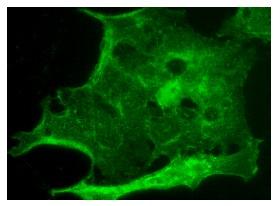
Immunofluorescence staining of formalin-fixed Hep G2 cells showing membrane localization.Application
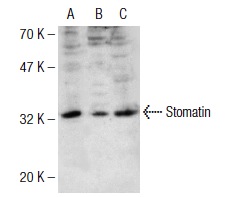
Western blot analysis of Stomatin expression in MEG-01 (A), WI 38 (B) and Hep G2 (C) whole cell lysates.| Product Name | Stomatin Antibody (H-45) |
|---|---|
| Antibody Type | Primary Antibodies |
| Modification Notes | Stomatin is an integral membrane protein found in lipid/protein-rich microdomains of almost all human tissues. It was named after the rare human disease haemolytic anaemia hereditary stomatocytosis. Stomatin is implicated in signal transduction and cell communication, and it may regulate cation movement through ion channels and transporters. Absence of Stomatin may cause Na+ and K+ ions to leak into and from erythrocytes. A second function of Stomatin may be to act as a cytoskeletal anchor. Stomatin is a major lipid-raft component of erythrocytes and epithelial cells, and is also an abundant platelet protein. It contains a single hydrophobic domain, close to the N-terminus, and a phosphorylation site. |
| Clonality | Polyclonal |
|---|---|
| Isotype | IgG |
| Host Species | Rabbit |
| Tested Applications | WBIPIFELISA |
| recommended for detection of Stomatin of human origin by WB, IP, IF and ELISA also reactive with additional species, including canine | |
| Species Reactivity | HumanMouseRat |
| Concentration | 1mg/ml |
| Purification | Affinity purified |
| Alternative Names | epitope corresponding to amino acids 1-45 mapping at the N-terminus of Stomatin of human origin |
|---|---|
| Tissue Specificity | epitope corresponding to amino acids 1-45 mapping at the N-terminus of Stomatin of human origin |
| Entrez Gene | 2040 |
|---|
Application
Immunofluorescence staining of formalin-fixed Hep G2 cells showing membrane localization.
Application
Western blot analysis of Stomatin expression in MEG-01 (A), WI 38 (B) and Hep G2 (C) whole cell lysates.| Application Notes | recommended for detection of Stomatin of human origin by WB, IP, IF and ELISA also reactive with additional species, including canine |
|---|
| Form | Liquid |
|---|---|
| Storage Instructions | For short-term storage, store at 4° C. For long-term storage, aliquot and store at -20ºC or below. Avoid multiple freeze-thaw cycles. |
| Storage Buffer | phosphate buffered saline , pH 7.4, 150mM NaCl, 0.02% sodium azide and 50% glycerol. |


