Application
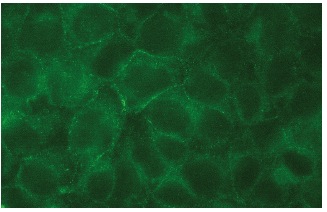
Immunofluorescence staining of methanol-fixed HeLa cells showing membrane localization.| Product Name | UNC93B1 Antibody (E-12) |
|---|---|
| Antibody Type | Primary Antibodies |
| Modification Notes | UNC93B1 (UNC93 homolog B1), also known as UNC93 or UNC93B, is a 597 amino acid multi-pass membrane protein that is the human homolog of C. elegans unc93, a protein involved in the coordination and regulation of muscle contraction. Expressed in various tissues including heart and kidney, UNC93B1 localizes to the endoplasmic reticulum (ER) and is responsible for shuttling TLR7 (toll-like receptor 7) and TLR9 (toll-like receptor 9) from the ER to the endolysosomes, an event that leads to the subsequent activation of TLR7 and TLR9. Defects in the gene encoding UNC93B1 are associated with an increased susceptibility to herpes simplex encephalitis (HSE), a form of human herpesvirus (HHV) that is characterized by hemorrhagic necrosis of parts of the temporal and frontal lobes that often leads to death. Additionally, mutations in the UNC93B1 gene may be a cause of left ventricular diastolic heart failure in elderly men, suggesting an important role for UNC93B1 in proper heart function. |
| Clonality | Polyclonal |
|---|---|
| Isotype | IgG |
| Host Species | Rabbit |
| Tested Applications | WBIFELISA |
| recommended for detection of UNC93B1 of mouse, rat and human origin by WB, IF and ELISA non cross-reactive with UNC93A or UNC93B6 also reactive with additional species, including equine, canine, bovine and porcine | |
| Species Reactivity | HumanMouseRat |
| Concentration | 1mg/ml |
| Purification | Affinity purified |
| Alternative Names | epitope mapping near the N-terminus of UNC93B1 of human origin |
|---|---|
| Tissue Specificity | epitope mapping near the N-terminus of UNC93B1 of human origin |
| Entrez Gene | 81622 |
|---|
Application
Immunofluorescence staining of methanol-fixed HeLa cells showing membrane localization.| Application Notes | recommended for detection of UNC93B1 of mouse, rat and human origin by WB, IF and ELISA non cross-reactive with UNC93A or UNC93B6 also reactive with additional species, including equine, canine, bovine and porcine |
|---|
| Form | Liquid |
|---|---|
| Storage Instructions | For short-term storage, store at 4° C. For long-term storage, aliquot and store at -20ºC or below. Avoid multiple freeze-thaw cycles. |
| Storage Buffer | phosphate buffered saline , pH 7.4, 150mM NaCl, 0.02% sodium azide and 50% glycerol. |


