Application
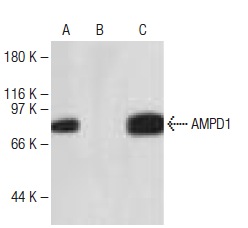
Western blot analysis of AMPD1 expression in mouse skeletal muscle tissue extract in the absence (A) and the presence (B) of immunizing peptide and rat skeletal muscle (C) tissue extract.| Product Name | AMPD1 Antibody (P-21) |
|---|---|
| Antibody Type | Primary Antibodies |
| Modification Notes | Adenosine monophosphate (AMP) deaminase is a cytosolic enzyme responsible for the hydrolytic deamination of AMP to inosine monophosphate (IMP) and NH3. AMP deaminase functions as a homotetramer and participates in the purine nucleotide cycle, playing an important role in energy metabolism. Three differentially expressed isozymes of AMP deaminase exist in mammals, namely AMPD1, AMPD2 and AMPD3, and they differ among their N-terminal domains while sharing a conserved C-terminal catalytic domain. AMPD1 is expressed in skeletal muscle; AMPD2 is found in undifferentiated myoblasts, smooth muscle, embryonic muscle and non-muscle tissue; and AMPD3 is expressed in erythrocytes. Defects in the AMPD1 gene result in adenosine monophosphate deaminase deficiency muscle type (AMPDDM). AMPDDM is a metabolic disorder resulting in exercise-related myopathy and is characterized by exercise-induced muscle aches, cramps, and early fatigue. |
| Clonality | Polyclonal |
|---|---|
| Isotype | IgG |
| Host Species | Rabbit |
| Tested Applications | WBIPIFIHC |
| Species Reactivity | HumanMouseRat |
| Concentration | 1mg/ml |
| Purification | Affinity purified |
| Alternative Names | recommended for detection of AMPD1 of mouse rat and human origin by WB IP IF and IHC(P) also reactive with additional species including bovine and canine |
|---|---|
| Tissue Specificity | recommended for detection of AMPD1 of mouse, rat and human origin by WB, IP, IF and IHC(P); also reactive with additional species, including bovine and canine |
| Entrez Gene | 270 |
|---|
Application
Western blot analysis of AMPD1 expression in mouse skeletal muscle tissue extract in the absence (A) and the presence (B) of immunizing peptide and rat skeletal muscle (C) tissue extract.| Form | Liquid |
|---|---|
| Storage Instructions | For short-term storage, store at 4° C. For long-term storage, aliquot and store at -20ºC or below. Avoid multiple freeze-thaw cycles. |
| Storage Buffer | phosphate buffered saline , pH 7.4, 150mM NaCl, 0.02% sodium azide and 50% glycerol. |


