Application
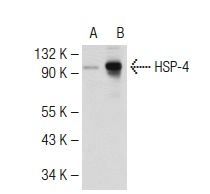
Western blot analysis of HPS-4 expression in non-transfected: (A) and human HPS-4 transfected: (B) 293T whole cell lysates.Application
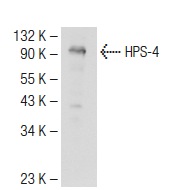
Western blot analysis of HPS-4 expression in HL-60 whole cell lysate.| Product Name | HPS-4 Antibody (H-150) |
|---|---|
| Antibody Type | Primary Antibodies |
| Modification Notes | Hermansky-Pudlak syndrome (HPS) is a rare, genetically heterogeneous, autosomal recessive disorder. It is characterized by oculocutaneous albinism, lysosomal storage defects and prolonged bleeding due to platelet storage pool deficiency. There are 10 HPS genes encoding HPS proteins that all interact within three distinct ubiquitously expressed protein complexes or biogenesis of lysosome-related organelle complexes. Defects in these genes cause HPS. HPS-4, also designated light-ear protein homolog, is important in organelle biosynthesis. Defects in the gene encoding for the HSP-4 protein, HPS4, can cause Hermansky-Pudlak syndrome 4 (HPS4). |
| Clonality | Polyclonal |
|---|---|
| Isotype | IgG |
| Host Species | Rabbit |
| Tested Applications | WBIPIFELISA |
| recommended for detection of Hermansky-Pudlak Syndrome Protein 4 of human origin by WB, IP, IF and ELISA | |
| Species Reactivity | HumanMouseRat |
| Concentration | 1mg/ml |
| Purification | Affinity purified |
| Alternative Names | epitope corresponding to amino acids 471-620 mapping near the C-terminus of HPS-4 of human origin |
|---|---|
| Tissue Specificity | epitope corresponding to amino acids 471-620 mapping near the C-terminus of HPS-4 of human origin |
Application
Western blot analysis of HPS-4 expression in non-transfected: (A) and human HPS-4 transfected: (B) 293T whole cell lysates.
Application
Western blot analysis of HPS-4 expression in HL-60 whole cell lysate.| Application Notes | recommended for detection of Hermansky-Pudlak Syndrome Protein 4 of human origin by WB, IP, IF and ELISA |
|---|
| Form | Liquid |
|---|---|
| Storage Instructions | For short-term storage, store at 4° C. For long-term storage, aliquot and store at -20ºC or below. Avoid multiple freeze-thaw cycles. |
| Storage Buffer | phosphate buffered saline , pH 7.4, 150mM NaCl, 0.02% sodium azide and 50% glycerol. |


