Application
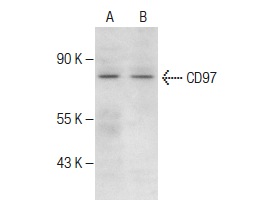
Western blot analysis of CD97 expression in SUP-T1 (A) and HeLa (B) whole cell lysates.| Product Name | CD97 Antibody (H-245) |
|---|---|
| Antibody Type | Primary Antibodies |
| Modification Notes | CD97 is a member of the EGF-TM7 (seven-span transmembrane) protein family, which is characterized by an extended extracellular region with a variable number of N-terminal EGF-like domains coupled to a TM7 stalk. It is expressed by leukocytes following activation. CD97 binds to its cellular ligand CD55 (decay accelerating factor) and protects several cell types from complement-mediated damage. The CD97-CD55 interaction may play a role in cellular activation, migration and adhesion following inflammation. CD97 expression is increased in thyroid cancer, paralleling dedifferentiation and tumor staging in this disease. Many colorectal cell lines are also CD97+, with CD97 levels correlating with migration and invasion in vitro. CD97 is also expressed in various gastric, pancreatic and esophageal carcinomas. CD97 shares significant homology with EMR2, however the two proteins exhibit different expression patterns, as EMR2 is not expressed in any of the aforementioned cancer cells. |
| Clonality | Polyclonal |
|---|---|
| Isotype | IgG |
| Host Species | Rabbit |
| Tested Applications | WBIPIFELISA |
| recommended for detection of CD97 of human origin by WB, IP, IF and ELISA | |
| Species Reactivity | HumanMouseRat |
| Concentration | 1mg/ml |
| Purification | Affinity purified |
| Alternative Names | epitope corresponding to amino acids 287-531 mapping within an internal region of CD97 of human origin |
|---|---|
| Tissue Specificity | epitope corresponding to amino acids 287-531 mapping within an internal region of CD97 of human origin |
| Entrez Gene | 976 |
|---|
Application
Western blot analysis of CD97 expression in SUP-T1 (A) and HeLa (B) whole cell lysates.| Application Notes | recommended for detection of CD97 of human origin by WB, IP, IF and ELISA |
|---|
| Form | Liquid |
|---|---|
| Storage Instructions | For short-term storage, store at 4° C. For long-term storage, aliquot and store at -20ºC or below. Avoid multiple freeze-thaw cycles. |
| Storage Buffer | phosphate buffered saline , pH 7.4, 150mM NaCl, 0.02% sodium azide and 50% glycerol. |


