Application
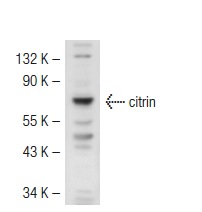
Western blot analysis of citrin expression in Hep G2 whole cell lysate.| Product Name | citrin Antibody (H-69) |
|---|---|
| Antibody Type | Primary Antibodies |
| Modification Notes | Citrin, also known as SLC25A13 (Solute carrier family 25 member 13), ARALAR2 or CTLN2, is a 675 amino acid multi-pass membrane protein that localizes to the inner membrane of the mitochondrion. Expressed in liver, pancreas, kidney, brain, heart and placenta, citrin functions as a calcium-dependent glutamate and aspartate carrier that is thought to play a role in the urea cycle. Citrin, a member of the mitochondrial carrier family, contains three Solcar repeats and four EF-hand domains through which it binds calcium. Defects in the gene encoding citrin are the cause of citrullinemia type 2 (CTLN2) and neonatal intrahepatic cholestasis due to citrin deficiency (NICCD). CTLN2 is an autosomal recessive disease that results from errors in the urea cycle and is characterized by neuropsychiatric symptoms such as loss of memory, seizures and coma. NICCD, a non-lethal disorder, occurs during infancy and is characterized by low birth weight, reduced bile flow, growth retardation and hepatic fibrosis. |
| Clonality | Polyclonal |
|---|---|
| Isotype | IgG |
| Host Species | Rabbit |
| Tested Applications | WBIPIFELISA |
| recommended for detection of citrin of mouse and human origin by WB, IP, IF and ELISA also reactive with additional species, including canine and porcine | |
| Species Reactivity | HumanMouseRat |
| Concentration | 1mg/ml |
| Purification | Affinity purified |
| Alternative Names | epitope corresponding to amino acids 1-68 mapping at the N-terminus of citrin of human origin |
|---|---|
| Tissue Specificity | epitope corresponding to amino acids 1-68 mapping at the N-terminus of citrin of human origin |
| Entrez Gene | 10165 |
|---|
Application
Western blot analysis of citrin expression in Hep G2 whole cell lysate.| Application Notes | recommended for detection of citrin of mouse and human origin by WB, IP, IF and ELISA also reactive with additional species, including canine and porcine |
|---|
| Form | Liquid |
|---|---|
| Storage Instructions | For short-term storage, store at 4° C. For long-term storage, aliquot and store at -20ºC or below. Avoid multiple freeze-thaw cycles. |
| Storage Buffer | phosphate buffered saline , pH 7.4, 150mM NaCl, 0.02% sodium azide and 50% glycerol. |


