Application
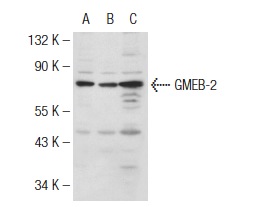
Western blot analysis of GMEB-2 expression in K-562 (A), HeLa (B) and Jurkat (C) nuclear extracts.| Product Name | GMEB-2 Antibody (H-107) |
|---|---|
| Antibody Type | Primary Antibodies |
| Modification Notes | GMEB-2 (glucocorticoid modulatory element binding protein 2), also known as PIF79 (Parvovirus initiation factor p79) or P79PIF, is a DNA-binding protein that plays a crucial role modulating transcription upon activation by steroid hormones. GMEB-2 is ubiquitously expressed with preferential expression in developmentally important tissues, such as testis, bone marrow, placenta and fetal tissues. It localizes to the nucleus and cytoplasm and contains a SAND domain near its N-terminus and a C-terminal coiled coil structure. GMEB-2 functions as a homodimer or as a heterodimer with GMEB-1. The formed complex specifically binds to glucocorticoid modulatory elements (GME) in the promoter region of target genes and recruits the histone acetylase CREB binding protein (CBP) during glucocorticoid signaling. This acts to increase sensitivity to low concentrations of glucocorticoids. In addition, GMEB-2 functions as an auxiliary factor required for parvovirus replication. |
| Clonality | Polyclonal |
|---|---|
| Isotype | IgG |
| Host Species | Rabbit |
| Tested Applications | WBIPIFELISA |
| recommended for detection of GMEB-2 of mouse, rat and human origin by WB, IP, IF and ELISA non cross-reactive with GMEB-1 also reactive with additional species, including equine, canine and bovine | |
| Species Reactivity | HumanMouseRat |
| Concentration | 1mg/ml |
| Purification | Affinity purified |
| Alternative Names | epitope corresponding to amino acids 361-465 mapping near the C-terminus of GMEB-2 of human origin |
|---|---|
| Tissue Specificity | epitope corresponding to amino acids 361-465 mapping near the C-terminus of GMEB-2 of human origin |
| Entrez Gene | 26205 |
|---|
Application
Western blot analysis of GMEB-2 expression in K-562 (A), HeLa (B) and Jurkat (C) nuclear extracts.| Application Notes | recommended for detection of GMEB-2 of mouse, rat and human origin by WB, IP, IF and ELISA non cross-reactive with GMEB-1 also reactive with additional species, including equine, canine and bovine |
|---|
| Form | Liquid |
|---|---|
| Storage Instructions | For short-term storage, store at 4° C. For long-term storage, aliquot and store at -20ºC or below. Avoid multiple freeze-thaw cycles. |
| Storage Buffer | phosphate buffered saline , pH 7.4, 150mM NaCl, 0.02% sodium azide and 50% glycerol. |


