Application
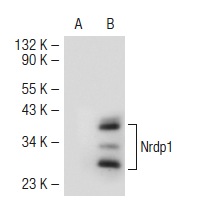
Western blot analysis of Nrdp1 expression in non-transfected: (A) and human Nrdp1 transfected: (B) 293T whole cell lysates.| Product Name | Nrdp1 Antibody (FL-317) |
|---|---|
| Antibody Type | Primary Antibodies |
| Modification Notes | The RING-type zinc finger motif is present in a number of viral and eukaryotic proteins and is made of a conserved cysteine-rich domain that is able to bind two zinc atoms. Proteins that contain this conserved domain are generally involved in the ubiquitination pathway of protein degradation. Nrdp1, also known as RNF41 (RING finger protein 41), SBBI03 or FLRF, is a 317 amino acid protein that contains one RING-type zinc finger and one SIAH-type zinc finger. Expressed in testis, ovary and prostate, Nrdp1 functions as an E3 ubiquitin-protein ligase that, characteristic of E3 ligase proteins, accepts ubiquitin (in the form of a thioester) from an E2 ubiquitin-conjugating enzyme and transfers that ubiquitin residue to substrates targeted for degradation. Specifically, Nrdp1 interacts with ErbB-3 and UBPY, thereby targeting them for proteasomal degradation. |
| Clonality | Polyclonal |
|---|---|
| Isotype | IgG |
| Host Species | Rabbit |
| Tested Applications | WBIPIFELISA |
| recommended for detection of Nrdp1 of mouse, rat and human origin by WB, IP, IF and ELISA also reactive with additional species, including equine, canine, bovine and porcine | |
| Species Reactivity | HumanMouseRat |
| Concentration | 1mg/ml |
| Purification | Affinity purified |
| Alternative Names | epitope corresponding to amino acids 1-317 representing full length Nrdp1 of human origin |
|---|---|
| Tissue Specificity | epitope corresponding to amino acids 1-317 representing full length Nrdp1 of human origin |
| Entrez Gene | 10193 |
|---|
Application
Western blot analysis of Nrdp1 expression in non-transfected: (A) and human Nrdp1 transfected: (B) 293T whole cell lysates.| Application Notes | recommended for detection of Nrdp1 of mouse, rat and human origin by WB, IP, IF and ELISA also reactive with additional species, including equine, canine, bovine and porcine |
|---|
| Form | Liquid |
|---|---|
| Storage Instructions | For short-term storage, store at 4° C. For long-term storage, aliquot and store at -20ºC or below. Avoid multiple freeze-thaw cycles. |
| Storage Buffer | phosphate buffered saline , pH 7.4, 150mM NaCl, 0.02% sodium azide and 50% glycerol. |


