Application
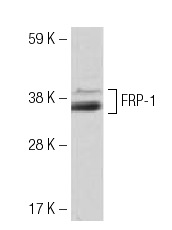
Western blot analysis of FRP-1 expression in human fetal kidney tissue extract.| Product Name | FRP-1 Antibody (G-25) |
|---|---|
| Antibody Type | Primary Antibodies |
| Modification Notes | The frizzled gene, originally identified in Drosophila melanogaster, is involved in the development of tissue polarity. The mammalian homolog of frizzled as well as several secreted mammalian frizzled-related proteins, FRP-1 (also designated SARP2), FRP-2 (also designated SARP1), FRP-3, FRP-4 and SARP3 (also designated FRP-5), have been identified. The Frizzled proteins contain seven transmembrane domains, a cysteine-rich domain in the extracellular region and a carboxy terminal Ser/Thr-xxx-Val motif, and they function as receptors for Wnt. The Frizzled-1 gene maps to human chromosome 7q21 and is expressed in adult heart, placenta, lung, kidney, pancreas, prostate and ovary and in fetal lung and kidney. Frizzled-2 is expressed in adult heart and fetal brain, lung and kidney. The frizzled related proteins FRP-1, FRP-2, FRP-3, FRP-4 and SARP3 are secreted proteins that contain regions of homology to the cysteine-rich ligand-binding domain of frizzled and a conserved hydrophilic carboxy terminal. The gene encoding human SARP3 maps to chromosome 4q31.3 and is expressed in retinal pigment epithelium (RPE) and pancreas, while expression of FRP-1,2 and 4 is high in developing tissues. The FRPs/SARPs are involved in the Wnt signaling pathway by regulating the intracellular levels of b-catenin. |
| Clonality | Polyclonal |
|---|---|
| Isotype | IgG |
| Host Species | Rabbit |
| Tested Applications | WBIPELISA |
| Species Reactivity | HumanMouseRat |
| Concentration | 1mg/ml |
| Purification | Affinity purified |
| Alternative Names | recommended for detection of FRP-1 of h and r origin by WB IP and ELISA also reactive with additional species including canine |
|---|---|
| Tissue Specificity | recommended for detection of FRP-1 of h and r origin by WB, IP and ELISA; also reactive with additional species, including canine |
| Entrez Gene | 6422 |
|---|
Application
Western blot analysis of FRP-1 expression in human fetal kidney tissue extract.| Form | Liquid |
|---|---|
| Storage Instructions | For short-term storage, store at 4° C. For long-term storage, aliquot and store at -20ºC or below. Avoid multiple freeze-thaw cycles. |
| Storage Buffer | phosphate buffered saline , pH 7.4, 150mM NaCl, 0.02% sodium azide and 50% glycerol. |


