Application
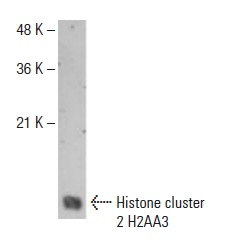
Western blot analysis of Histone cluster 2 H2AA3 expression in Jurkat whole cell lysate.| Product Name | Histone cluster 2 H2AA3 Antibody (W-25) |
|---|---|
| Antibody Type | Primary Antibodies |
| Modification Notes | Eukaryotic histones are basic and water soluble nuclear proteins that form hetero-octameric nucleosome particles by wrapping 146 base pairs of DNA in a left-handed super-helical turn sequentially to form chromosomal fiber. Two molecules of each of the four core histones (H2A, H2B, H3 and H4) form the octamer, which is comprised of two H2A-H2B dimers and two H3-H4 dimers, forming two nearly symmetrical halves by tertiary structure. Histones are subject to posttranslational modification by enzymes primarily on their N-terminal tails, but also in their globular domains. Histone cluster 2 H2AA3, also known as H2A, H2A.2, H2A/O, H2A/q, H2AFO, H2a-615, HIST2H2AA, HIST2H2AA4 or HIST2H2AA3, is a 130 amino acid nuclear protein belonging to the histone H2A family. HIST2H2AA3 is encoded by a gene located on human chromosome 1, which spans 260 million base pairs, contains over 3,000 genes and comprises nearly 8% of the human genome. |
| Clonality | Polyclonal |
|---|---|
| Isotype | IgG |
| Host Species | Rabbit |
| Tested Applications | WBIPELISA |
| Species Reactivity | HumanMouseRat |
| Concentration | 1mg/ml |
| Purification | Affinity purified |
| Alternative Names | recommended for detection of Histone cluster 2 H2AA3 of mouse rat and human origin by WB IP and ELISA |
|---|---|
| Tissue Specificity | recommended for detection of Histone cluster 2 H2AA3 of mouse, rat and human origin by WB, IP and ELISA |
| Entrez Gene | 8337 |
|---|
Application
Western blot analysis of Histone cluster 2 H2AA3 expression in Jurkat whole cell lysate.| Form | Liquid |
|---|---|
| Storage Instructions | For short-term storage, store at 4° C. For long-term storage, aliquot and store at -20ºC or below. Avoid multiple freeze-thaw cycles. |
| Storage Buffer | phosphate buffered saline , pH 7.4, 150mM NaCl, 0.02% sodium azide and 50% glycerol. |


