Application
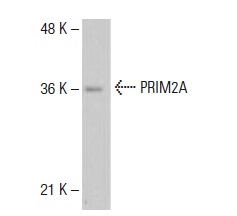
Western blot analysis of PRIM2A expression in Hep G2 whole cell lysate.| Product Name | PRIM2A Antibody (L-21) |
|---|---|
| Antibody Type | Primary Antibodies |
| Modification Notes | In eukaryotic cells, the replication of DNA is carried out by a variety of proteins and requires a complex chromosomal replication structure, of which POLA2 (DNA polymerase alpha) and DNA primases (PRIMs) are key components. PRIM2A (primase, DNA, polypeptide 2A), also known as p58, is a 509 amino acidprotein that exists as a heterodimer with PRIM1, another DNA primase. Together, PRIM2A and PRIM1 function to synthesize small RNA primers that are required for the proper activity of Okazaki fragments during replication of the DNA lagging strand. Multiple isoforms of PRIM2A exist due to alternative splicing events. The gene encoding PRIM2A maps to human chromosome 6, which contains 170 million base pairs and comprises nearly 6% of the human genome. Deletion of a portion of the q arm of chromosome 6 is associated with early onset intestinal cancer, suggesting the presence of a cancer susceptibility locus. Additionally, Porphyria cutanea tarda, Parkinson's disease, Stickler syndrome and a susceptibility to bipolar disorder are all associated with genes that map to chromosome 6. |
| Clonality | Polyclonal |
|---|---|
| Isotype | IgG |
| Host Species | Rabbit |
| Tested Applications | WBIPELISA |
| Species Reactivity | HumanMouseRat |
| Concentration | 1mg/ml |
| Purification | Affinity purified |
| Alternative Names | recommended for detection of PRIM2A of human origin by WB IP and ELISA |
|---|---|
| Tissue Specificity | recommended for detection of PRIM2A of human origin by WB, IP and ELISA |
| Entrez Gene | 5558 |
|---|
Application
Western blot analysis of PRIM2A expression in Hep G2 whole cell lysate.| Form | Liquid |
|---|---|
| Storage Instructions | For short-term storage, store at 4° C. For long-term storage, aliquot and store at -20ºC or below. Avoid multiple freeze-thaw cycles. |
| Storage Buffer | phosphate buffered saline , pH 7.4, 150mM NaCl, 0.02% sodium azide and 50% glycerol. |


