Application
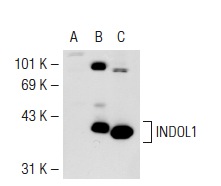
Western blot analysis of INDOL1 expression in non-transfected 293T: (A), mouse INDOL1 transfected 293T: (B) and Hep G2 (C) whole cell lysates.| Product Name | INDOL1 Antibody (N-17) |
|---|---|
| Antibody Type | Primary Antibodies |
| Modification Notes | Tryptophan is an essential amino acid that is necessary for protein synthesis, serotonin and melatonin biosynthesis and energy production; energy being a product of the catabolism of tryptophan through the kynurenine pathway. The kynurenine pathway has many downstream metabolites which may be a part of physiological or patho-physiological processes. INDOL1 (indoleamine 2,3-dioxygenase-like protein 1) is an enzyme that catalyzes the first step of the kynurenine pathway of tryptophan metabolism. INDOL1 is also known as IDO2 (indoleamine 2,3-dioxygenase 2) and is a 407 amino acid protein that is expressed in various tissues, including liver, small intestine, spleen, placenta, thymus, lung, brain, kidney, colon and dendritic cells. INDOL1 is selectively inhibited by D-1MT (1-methyl-d-tryptophan), which also inhibits IDO (indoleamine 2,3-dioxygenase) and is significant because IDO expression causes suppression of T cell responses to tumors in dendritic cells. The inhibition of INDOL1 by D-1MT suggests a common function in immunomodulation. In the human INDOL1 gene, two single nucleotide polymorphisms have been detected which abolish the enzymatic function of INDOL1. |
| Clonality | Polyclonal |
|---|---|
| Isotype | IgG |
| Host Species | Rabbit |
| Tested Applications | WBIPIFELISA |
| recommended for detection of INDOL1 of mouse and human origin by WB, IP, IF and ELISA | |
| Species Reactivity | HumanMouseRat |
| Concentration | 1mg/ml |
| Purification | Affinity purified |
| Alternative Names | epitope mapping near the N-terminus of INDOL1 of human origin |
|---|---|
| Tissue Specificity | epitope mapping near the N-terminus of INDOL1 of human origin |
| Entrez Gene | 169355 |
|---|
Application
Western blot analysis of INDOL1 expression in non-transfected 293T: (A), mouse INDOL1 transfected 293T: (B) and Hep G2 (C) whole cell lysates.| Application Notes | recommended for detection of INDOL1 of mouse and human origin by WB, IP, IF and ELISA |
|---|
| Form | Liquid |
|---|---|
| Storage Instructions | For short-term storage, store at 4° C. For long-term storage, aliquot and store at -20ºC or below. Avoid multiple freeze-thaw cycles. |
| Storage Buffer | phosphate buffered saline , pH 7.4, 150mM NaCl, 0.02% sodium azide and 50% glycerol. |


