Application
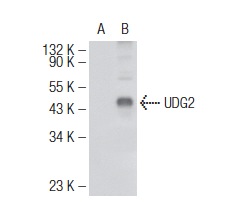
Western blot analysis of UDG2 expression in non-transfected: (A) and human UDG2 transfected: (B) 293T whole cell lysates.| Product Name | UDG2 Antibody (H-267) |
|---|---|
| Antibody Type | Primary Antibodies |
| Modification Notes | Cell proliferation is controlled at specific stages of the cell cycle by distinct protein kinase complexes. These complexes consist of a catalytic subunit associating with a specific regulatory subunit to form the active kinase. The cyclins, which include cyclin A, B, C, D, E, F, G, H, I, K, L, O, T and their related proteins, comprise the regulatory subunits of these kinase complexes. The controlled activation of the kinase complexes at various intervals of the cell cycle is regulated by the availability of the cyclins to the catalytic subunit. Unlike the catalytic subunit, which is expressed continually, the expression and stability of the regulatory subunit fluctuates depending on the stage of the cell cycle, thereby regulating kinase activity. UDG2 (Uracil-DNA glycosylase 2), also known as cyclin O or CCNO, is a 350 amino acid member of the cyclin family that plays a role in DNA repair, specifically by excising misincorporated uracil residues from DNA. |
| Clonality | Polyclonal |
|---|---|
| Isotype | IgG |
| Host Species | Rabbit |
| Tested Applications | WBIPIFELISA |
| recommended for detection of UDG2 of mouse, rat and human origin by WB, IP, IF and ELISA also reactive with additional species, including equine, canine, bovine and porcine | |
| Species Reactivity | HumanMouseRat |
| Concentration | 1mg/ml |
| Purification | Affinity purified |
| Alternative Names | epitope corresponding to amino acids 1-267 mapping at the N-terminus of UDG2 of human origin |
|---|---|
| Tissue Specificity | epitope corresponding to amino acids 1-267 mapping at the N-terminus of UDG2 of human origin |
| Entrez Gene | 10309 |
|---|
Application
Western blot analysis of UDG2 expression in non-transfected: (A) and human UDG2 transfected: (B) 293T whole cell lysates.| Application Notes | recommended for detection of UDG2 of mouse, rat and human origin by WB, IP, IF and ELISA also reactive with additional species, including equine, canine, bovine and porcine |
|---|
| Form | Liquid |
|---|---|
| Storage Instructions | For short-term storage, store at 4° C. For long-term storage, aliquot and store at -20ºC or below. Avoid multiple freeze-thaw cycles. |
| Storage Buffer | phosphate buffered saline , pH 7.4, 150mM NaCl, 0.02% sodium azide and 50% glycerol. |


